
A Top Ten Brief on U.S.-China Issues on the Horizon
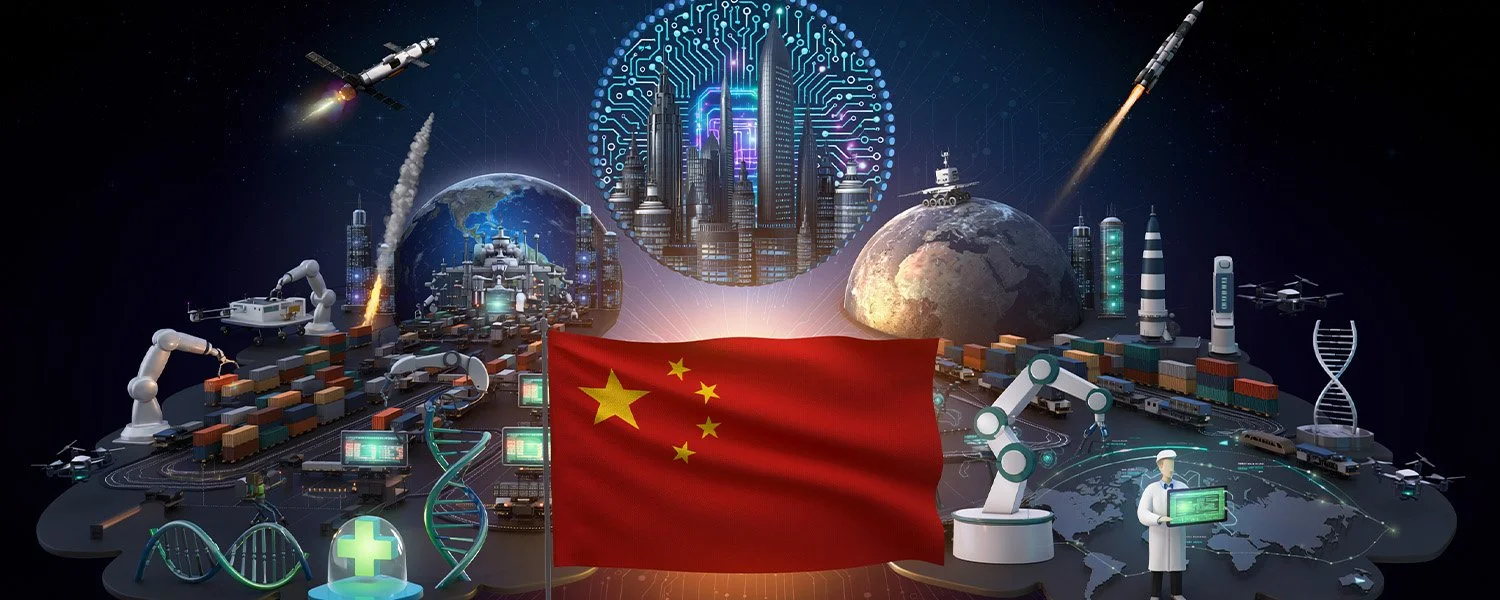
By N. MacDonnell Ulsch, Contributing Author / April 27, 2026
Mr. Ulsch, a U.S. registered Foreign Agent, is the Founder and Chief Analyst of Gray Zone Research & Intelligence—China Series, focusing on China’s technology-driven strategy for global economic supremacy. He advises the US Senate Committee on Foreign Relations on China’s cyber and technology transfer threats and has led incident investigations in 70 countries as a former Senior Managing Director at PwC’s cybercrime practice.
His research includes the impact of technology transfer on China’s economic strategy, US corporate regulatory risk, China’s supply chain penetration, and Military-Civil Fusion as a cyber threat. His LinkedIn China Polls have over 200,000 views and 25,000 followers.
Mr. Ulsch advises an East African presidential cabinet-in-exile on countering China’s Belt & Road Initiative. Previously, he served as a cyber threat advisor to the CIA, focusing on US cyber adversaries and attacks on the commercial sector and Defense Industrial Base. He also served on the US Secrecy Commission and advised a US presidential campaign on cybersecurity.
He is a Guest Lecturer on Cyber Warfare at West Point and a Research Fellow in the Master’s in Cybersecurity program at Boston College, which he helped establish.
Mr. Ulsch has authored two books: Cyber Threat: How to Manage the Growing Risk of Cyber Attacks and Threat! Managing Risk in a Hostile World. He is a Distinguished Fellow of the Ponemon Institute and serves as an Independent Director of a financial services company, focusing on cybersecurity and privacy issues.
As we move through 2026, here are a few things to think about as we enter into a new year of strife, conflict, threat analysis and containment, and emerging opportunity with the People's Republic of China.
The U.S.-China relationship has had many ups and downs, as we have moved manufacturing to China and then decided to move it back (at least in part) to the U.S. and to other nations to diversify economic and geopolitical risk, not to mention supply chain chokepoints.
Here are ten enduring flash points that seem unlikely to change in the near future, concerns that will require our devoted attention as the U.S.-China relationship evolves:
Taiwan. Some political and military analysts in China and the U.S. are predicting that we will be at war in the next few years with China over the strategic interests of Taiwan. China's show of force through military exercises and intimidation tactics may be indicators of war on the intermediate horizon or an attempt to forcefully shape policy through social media, public policy, and back-channel negotiations. China's Belt and Road Initiative requires target country allegiance to China over the Taiwan issue. This has proved to be a successful test of persuasion resulting in written agreement with the Chinese Communist Party over the issues of Taiwanese sovereignty. Target nation leadership must support the one-China rule or there is no investment.
Semiconductors. Not unrelated to the issue of Taiwan, there is the sale of NVIDIA's H200 chip to China, which was recently authorized by President Trump. The sale is expected to help China's artificial intelligence progress, while improving geopolitical and economic relations between the world's two largest superpowers. This is a national security versus economic issue. he U.S.-Taiwan relationship is strong and will become stronger as both countries continue to invest in advanced technologies, including semiconductor chips made in the U.S. We’ll have to see how it evolves.
Artificial Intelligence and Joint Ventures. China is moving aggressively to outpace the U.S. It has joint ventures in place that will help accelerate progress, especially with Samsung Electronics, which has about half a dozen AI centers. This model of R&D is concerning. The U.S. is involved, along with China. Yes, there are certain firewalls in place to prevent illicit transfer of intellectual property, but we should be suspect and cautious regarding the potential for intellectual property drift from one Samsung AI center in one country to another. Joint ventures such as this one seem to attract less regulatory scrutiny, which is a concern, which could end up with even more intellectual property compromise. There is also growing concern over the sale of AI technology by some nations to China. As always, intellectual property theft by China from the U.S remains an ongoing challenge. Advanced technology investments by China, including mergers and acquisitions, will continue to create disruption in the industry.
Hong Kong. The state of Hong Kong appears to be in perpetual conflict over the new versus old way of doing things. It seems Hong Kong is in decline, at least from the perspective of freedoms that were once enjoyed under British rule. China’s new Hong Kong National Security Law or NSL is making forceful changes. Companies will need to examine the wisdom and efficacy of remaining in the Hong Kong Administrative Region or seek alternative locations for Asia operations. Our China Poll of December 15, 2025, shows that 56 percent of those polled believe companies should seek alternative locations in Asia, while 44 percent voted for keeping operations in Hong Kong. Change is coming, either way.
Smart Cities. China continues to move Law Enforcement Management Systems (LEMS) and AI-enabled predictive policing technologies into evolving smart city locations in its strategic target range. This results in the ability of target nations to repress selected population segments that may disagree with the ruling government, while exploiting that nation's resources. The predicate for this is China's treatment of its Uyghur population.
Rare Earths & Pharmaceuticals. China maintains a near 90 percent lock on rare earths and other minerals needed for most everything we do, from smart phones to supercomputers. Negotiations are ongoing between the U.S. and China but for now, China maintains control. That may be said about antibiotics and other drugs. The supply chain favors China.
Space. Yes, the big adventure into the great beyond. Data centers in space. Supercomputers in space. Colonization of the moon. Delivering energy from space through Solar Power Satellites, a technology developed by the U.S. but abandoned several decades ago, only for China to pick up the baton. This has the potential to reshape the global energy markets by 2065. And then there is the militarization of space and a very crowded Low Earth Orbit with the potential for purposeful and inadvertent collisions of satellites.
Military-Civil Fusion. This is the drum beaten by the Chinese Communist Party (CCP), and the CCP has handed this mandate to Xi Jinping to successfully proliferate throughout China's technological landscape. The military may as well be in charge of technology development and deployment. This will become even more important as China's e-commerce initiative expands across the planet and space becomes the next battleground for national sovereignty. It seems the military is gaining power and momentum inside China, and potentially in China’s vast BRI network, as it integrates new technology infrastructure in these countries. How good can this be for the U.S. and our allies? This is an escalating threat scenario we will ahem to look at more closely in the coming year.
Fentanyl. This potent synthetic drug and its precursor chemical are very much a China issue. Though the attention is on Venezuela and Columbia right now, we will have to address this with China in a convincing manner. The success of U.S. efforts in stopping the boats filled with fentanyl will set the stage for further negotiations with China.
China’s Debt Status. There is no doubt China is racking up tremendous debts. China has a critical real estate debt crisis. It is pouring billions into its BRI, a strategic maneuver intended to place China in a trajectory to overtake U.S. GDP in the not too distant future—unless its economy collapses under the weight of its staggering debt. But China’s bet is that BRI and e-commerce will create new, lucrative markets with allegiance based on geopolitics and economic exchange. It is enhancing its e-commerce shipping plans, building new ships, and developing cold storage for food delivery, in the hope of being the food security blanket for the world.
The most critical concern we face with China will always be about the prospect of a hot war. There are many war triggers, and the ten issues cited here are, in part, representative of some of these triggers. However, one argument is that the more economically engaged we are with China, the less likely China will want to conduct a first strike in a war with the U.S.
All of the issues cited here are important. They are complicated. Some can even be exasperating. The most likely scenario of war with China will be a trade war, and a cyber war, in which, most would agree, we are already so engaged.
Trade wars will accelerate as China builds new markets in developing nations, and Cyber war will accelerate and expand into space as China continues to build weapons that have the capability to neutralize our satellites in Low Earth Orbit. These weapons include lasers, co-orbiting satellites, and ground-based offensive cyber weapons.
For 2026, we will witness, in some sense, more of the same. But we must keep in mind that both the U.S. and China will prepare for war as a defensive strategy intended to keep the other side mindful of the other’s military capability.
And then there is Russia. China will, as a strategy of peace through geopolitical alliances, keep Russia as the antagonist with NATO and, of course, the U.S. A Russia subservient to China is a great distraction for the U.S., which is, of course, exactly what China intends. While it is true that Russia president Vladimir Putin is a wildcard, with a history of erratic behavior, he has negotiated with China various economic, agricultural, and technological development incentives. While Putin may play the aggressor in public and not want to lose face over stunningly inept performance in Ukraine, there are two things he is not likely to do.
One, he is not likely to ignore China’s directions, even though he may seem to deviate from the script. Russia is too dependent on China assisting with Russian development in the future. And two, China’s nuclear security agreement with Ukraine, dating back to 1994 and reaffirmed in 2013, has so far restrained Putin from the deployment of tactical nuclear weapons on the Ukraine battlefield. The agreement requires China to come to the defense of Ukraine in the event it is threatened with a nuclear weapon.