
Battles That Built Modern Corporate Governance
By Christopher P. Skroupa, Skytop Founder and CEO / July 10, 2026
How Dan Burch and his MacKenzie Partners Influenced Shareholder Activism, Hostile Takeovers, and Boardroom Battles
Overview
When Dan Burch looks back on his six decades in the corporate trenches, he jokes that the memories blur together. But as he talks, the story sharpens into a vivid chronicle of how modern shareholder battles were born and how MacKenzie Partners emerged at the center of them.
Breaking Away and Building Something New
Burch co‑founded MacKenzie Partners in 1990 after he and two colleagues left DF King and briefly partnered with a New York investor relations firm. When that firm tried to renegotiate its deal, the trio walked, taking their clients, receivables, and even preferred stock with them.
“We capitalized the business ourselves,” Burch said. “We bought the preferred back for nickels on the dollar.” By 1992, MacKenzie Partners was fully independent and positioned to ride a wave of corporate upheaval.
The Wild Days of Hostile Takeovers
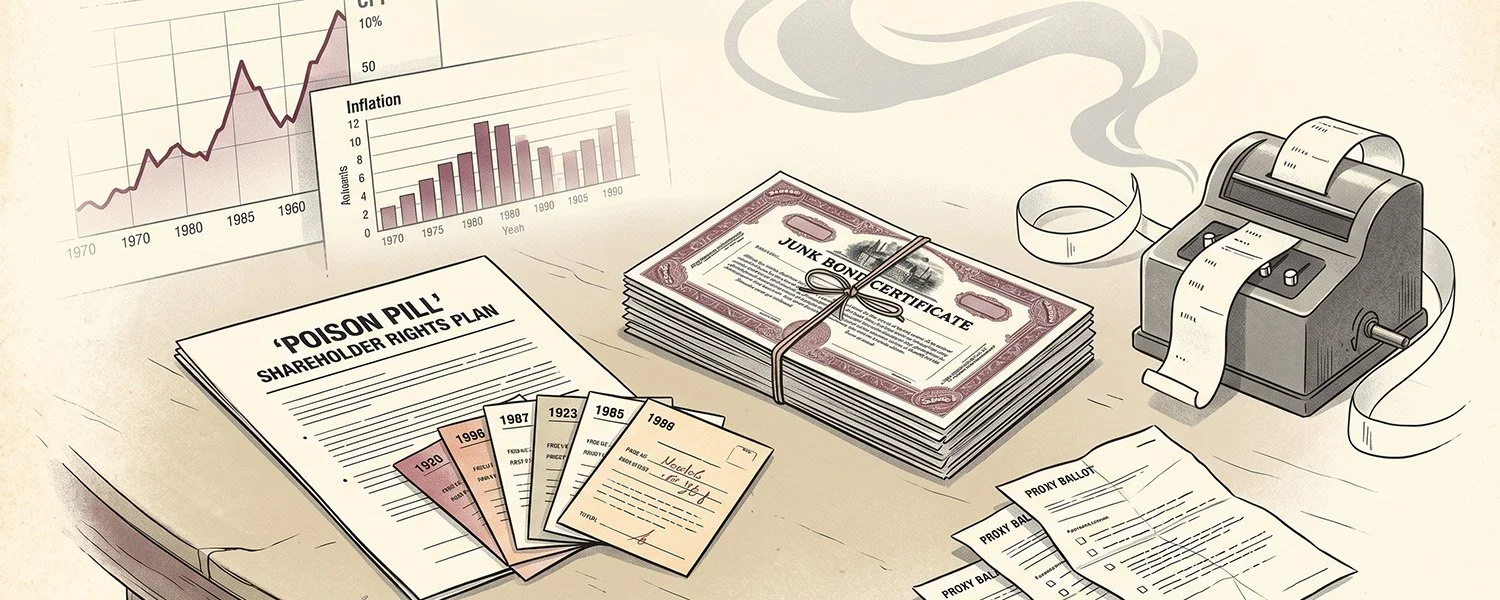
To understand the world MacKenzie entered, you must picture Wall Street in the 1970s and 80s: emergence out of a decade and a half of stagflation through the Reagan Administration's deregulation, Michael Milken’s high yield bonds, collapsing blue‑chip firms, and a new breed of corporate raiders who began challenging the status quo through holding boards accountable for performance.
“When I started, hostile bids were just beginning,” Burch said. “Morgan Stanley put them on the map.” Before that, control fights were fought through proxy contests — messy, personal, and often decided by technicalities. There were no proxy advisors, no electronic voting, and no standardized systems. Everything was manual.
“It was a different world,” Burch said. “Valid proxy cards, notices, signatures — all of it was contested.”
Raiders like T. Boone Pickens and Carl Icahn perfected the playbook: buy 5–10%, launch an offer, and force a sale or greenmail. Their campaigns targeted giants — Gulf Oil, Waste Management, Home Depot — and the outcomes spoke for themselves. Sleepy Wall Street experienced a welcome rebirth.
The Legal Arms Race and the Birth of the Poison Pill
As raiders grew more aggressive, so did the defense bar. Marty Lipton at Wachtell and Joe Flom at Skadden became the architects of modern takeover defense, culminating in the invention of the poison pill — a mechanism that diluted hostile bidders and changed the course of M&A.
“You could stop an offer cold,” Burch said. “But you couldn’t stop a proxy fight.” This distinction would define the next 40 years.
The Snake Pit and the Costliest Battles
In the early days, proxy votes were counted in what insiders called the snake pit — a room filled with lawyers, cigarettes, scotch, vodka, and arguments over every ballot. The tradition faded, but resurfaced spectacularly in the Procter & Gamble fight, one of the most expensive in history.
“HP might have been even more expensive,” Burch noted. “They ran full‑page ads in the Wall Street Journal and major regional papers.” HP/Compaq, decided by a razor‑thin 51–49 margin.
Other massive battles included:
Disney, where Roy Disney and Stanley Gold challenged management
DuPont, targeted by Trian
Tech fights like Metrographics/Quickturn
These were some of the campaigns that defined the modern era — sprawling, public, and fought across boardrooms, courtrooms, and the media.
Boards, CEOs, and the New Governance Reality
Boards today, Burch argues, are more engaged and more professional than ever. “People aren’t on five or six boards anymore,” he said. “If you’re on one or two, you can make a difference.”
But activism has made boards quicker to fire CEOs — sometimes too quick. “How much rope do you give a CEO?” Burch asked. “It’s very hard to judge.” Industries like tech and pharma complicate the picture. Product cycles, patent cliffs, and regulatory uncertainty can make even strong CEOs look weak.
“Cash flow can go to zero overnight,” he said. “No CEO can stop a patent from expiring.”
Activism’s Blind Spots
Raiders turned activists often assume that a falling stock price means shareholders have lost confidence in management. “Sometimes they haven’t,” Burch said. “Sometimes they believe in the CEO.” Burch points to recent examples — including the latest Disney battle — where management prevailed despite activist pressure.
“The more often activists are wrong, the healthier the market becomes,” he said.
ESG: Confusion, Politics, and Performance
When asked about ESG, Burch described a landscape defined by contradiction. “You’ve got companies digging in on DEI,” he said. “BlackRock shifting its tone. Some say ESG is here to stay; others say it’s dead.”
The core issue? “You can’t prove the investment case if ESG is driving the entire bus.” He points to Exxon as a cautionary tale: a company punished more for tone and posture than performance.
“Most active managers thought Exxon was doing the right thing,” he said. “But Chevron was getting more credit.” ESG works best, he argues, when it focuses on governance — the part investors can measure.
Enron, Andersen, and the Collapse of Trust
Burch’s perspective on Enron and Arthur Andersen is shaped by personal experience. Joe Berardino became president of Andersen just weeks before the scandal erupted. “He served as the scapegoat,” Burch said. “He did a remarkably good job given what he was up against.” The collapse exposed the inherent conflict of combining auditing with advisory services — a model mirrored in the Agilent “two‑step,” where firms offered both advisory services and accounting services that inherently presented a conflict of interest.
“It wasn’t illegal,” Burch said. “Almost everyone operated that way.”
The Compensation Explosion
For Burch, the deeper issue revealed by Enron wasn’t governance — it was compensation. “When someone gets a $500 million package, everyone else wants one,” he said. “We lost track of reality.” As the market soared, executive pay ballooned. Boards rationalized it by pointing to shareholder gains. Shareholders didn’t complain — until they did.
“It became a race to the bottom,” Burch said.
A Final Reflection
After nearly two hours of conversation, Burch paused, reflecting on the sweep of history — from the founding of MacKenzie Partners to the evolution of activism, governance, ESG, and corporate leadership.
“Some leaders are just in the wrong place at the wrong time,” he said. “All you can do is be a statesman and move through the process.”
It’s a fitting summary of a career spent navigating — and shaping — some of the most consequential corporate battles of the last half‑century.