
China’s Social Media Manipulation of South Sudan
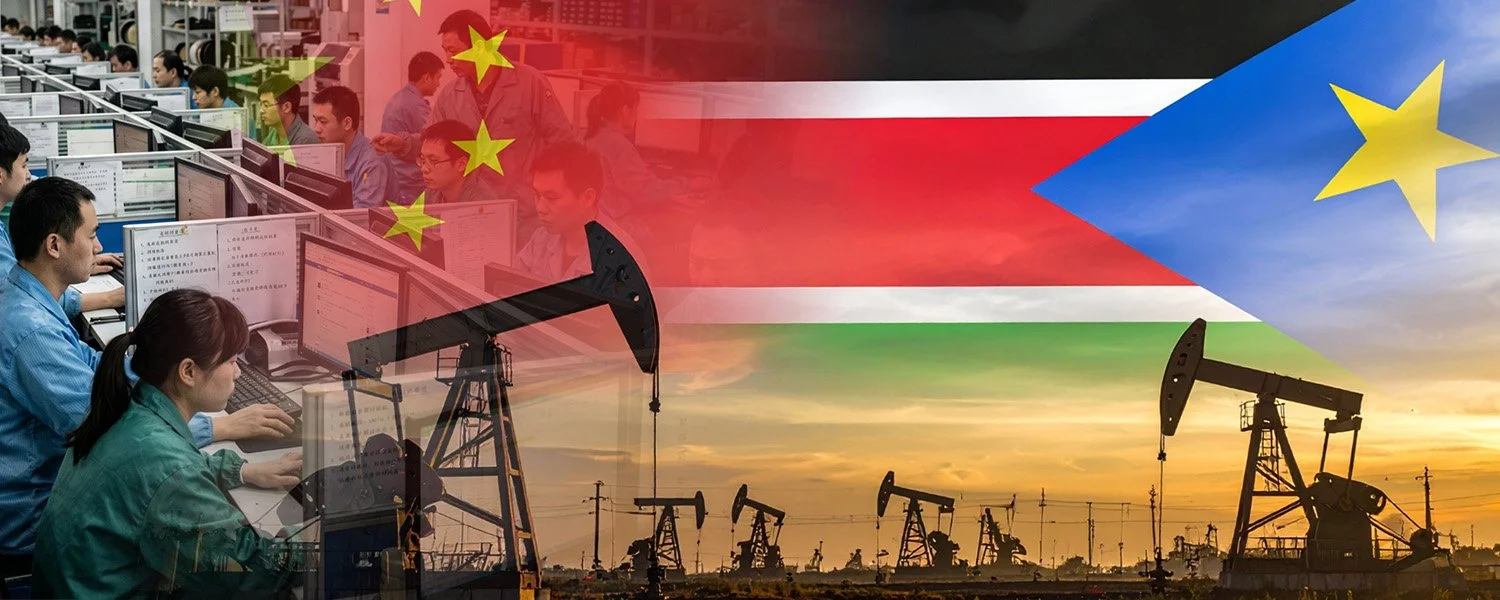
By N. MacDonnell Ulsch, Contributing Author / April 21, 2026
Mr. Ulsch, a U.S. registered Foreign Agent, is the Founder and Chief Analyst of Gray Zone Research & Intelligence—China Series, focusing on China’s technology-driven strategy for global economic supremacy. He advises the US Senate Committee on Foreign Relations on China’s cyber and technology transfer threats and has led incident investigations in 70 countries as a former Senior Managing Director at PwC’s cybercrime practice.
His research includes the impact of technology transfer on China’s economic strategy, US corporate regulatory risk, China’s supply chain penetration, and Military-Civil Fusion as a cyber threat. His LinkedIn China Polls have over 200,000 views and 25,000 followers.
Mr. Ulsch advises an East African presidential cabinet-in-exile on countering China’s Belt & Road Initiative. Previously, he served as a cyber threat advisor to the CIA, focusing on US cyber adversaries and attacks on the commercial sector and Defense Industrial Base. He also served on the US Secrecy Commission and advised a US presidential campaign on cybersecurity.
He is a Guest Lecturer on Cyber Warfare at West Point and a Research Fellow in the Master’s in Cybersecurity program at Boston College, which he helped establish.
Mr. Ulsch has authored two books: Cyber Threat: How to Manage the Growing Risk of Cyber Attacks and Threat! Managing Risk in a Hostile World. He is a Distinguished Fellow of the Ponemon Institute and serves as an Independent Director of a financial services company, focusing on cybersecurity and privacy issues.
This article was adapted from remarks made by Mr. Ulsch, a U.S. Registered Foreign Agent, at the Parliamentary Intelligence-Security Forum in Washington, D.C., December 9, 2025, in the United States Senate Russell Office building to international parliamentarians and members of the U.S. Congress.
Social media has in so many ways affected the trajectory and fabric of our culture, and, ultimately it will have shaped our history, for better or worse. But the Chinese Communist Party is not waiting for the future to show us lessons in history. China’s massive surveillance and monitoring program, coupled with its predictive policing program, has resulted in the detention of more than 1.3 million Uyghurs, a religious group that crossed into China in the tenth century. China is writing the book on social media and repression.
Twentieth century philosopher George Santayana once noted that “Those who cannot remember the past are condemned to repeat it.” The Chinese Communist Party remembers its past quite clearly, and it appears it may be preparing to repeat that history of persecution. But this time, its target population will not be in China but in Africa. In South Sudan, to be more specific.
Chinese Ambassador to South Sudan Ma Qiang, who is promoting Chinese modernization and economic cooperation in South Sudan, is also behind China’s promise of an aggressive social media campaign intended to keep in place Salva Kiir, the president of South Sudan. Kiir has remained in office largely because he keeps cancelling free and fair elections in South Sudan. This is, of course, to the benefit of China and not the people of South Sudan.
The China-South Sudan relationship works. For China, anyway. China loans billions of dollars in development work to the government of South Sudan. The government is one of the poorest in the world. But it’s oil reserves are what China is after, and China knows that the best way to gain access to and control over that national asset is to support Kiir.
Between 2000 and 2022, China has made investment commitments of $5.6 billion to South Sudan. In 2025, China offered an additional $8 billion in development funds. South Sudan is now seeking an additional $2.5 billion from both China and India. Kiir has controlled South Sudan for some 20 years and has formed a close relationship with China, which enriches not only China but Kiir.
China is willing to make substantial loans in order to benefit from South Sudanese oil. Ninety-eight percent of South Sudan’s revenue is from oil. This poorest of African nations has an estimated proven oil reserve of approximately 3.5 b billion barrels, making it one of the largest oil-rich countries in the continent. But South Sudan has not been able to make its debt service payments to China, so China now receives a generous share of revenue from 150,000 barrels of oil per day.
What China has its sights set on, though, is the anticipated increase in oil production to 450,000 barrels a day. With an average daily price per barrel of about $60, South Sudan makes about $9 million a day. But if South Sudan is producing 450,000 barrels daily, the revenue jumps to $27 million a day or about $9.855 billion a year. It has been observed that China’s take is about 40 percent or $3.942 billion a year. However there are varying estimates. It has been suggested that China does not actually take a fixed percentage. Rather Chinese state-owned companies such as CNPC (China National Petroleum Corporation) hold a 40 or 41 percent stake in key oil fields such as Dar Petroleum.
It is clear why China wants to do business with South Sudan, and why China wants Salva Kiir to remain in office. The numbers also work for Salva Kiir, who is said to take a comfortable commission on each barrel sold.
In either scenario, it behooves both parties, China and South Sudan, to delay presidential elections as long as possible to maintain the status quo. A prospective win by Bol Gai Deng, leader of the Kush Democratic Majority Party, would upset the current arrangement. Deng has publicly stated that he supports American values and would actively seek to reduce China’s footprint and stake in South Sudan. Deng, who was born in Sudan (before South Sudan separated from Sudan) but was forced to flee for his life, ultimately landed in Richmond, Virginia, through a charitable organization. He is a dual citizen of the United States and South Sudan. He has strong support from South Sudanese citizens around the world who also have had to flee their homeland, forming a very large diaspora, reaching many parts of the world.
CHINA’S COMMITMENT TO SOUTH SUDAN’S GOVERNMENT
In opposition to the Kush Democratic Party’s social media campaign, designed to support presidential candidate—in—exile Deng, China Ambassador to South Sudan Qiang recently went on record committing to the Kiir regime the technology, the technology specialists, and the financial funding to launch and sustain a social media initiative designed to keep Kiir in office. Through small and poor, South Sudan is not without importance to China. A success South Sudan in Africa for China translates into a successful elsewhere in Africa. It illustrates that China’s Belt and Road Initiative model can take a struggling country, a struggling president mired in controversy and corruption, and make that country a model of success, based on China’s metrics. But that is only the part that China wants the rest of the world to see.
What we don’t see are the natural landscapes in South Sudan savaged by China. We don’t see the natural habitats cut down, and the animals that once inhabited these forests killed. News of the deaths of young mothers, and the sickness and deaths of the young and weak, don’t make it into China’s social media campaigns, which laud the work of China and South Sudan as partners in building a better future. But better for whom? Certainly not for the suffering citizens of South Sudan.
We know that social media can be a powerful tool; a powerful weapon. China will showcase successes in South Sudan, buttressing Kiir’s regime. China will use social media to influence the public and an election, should one actually occur in 2026. Here is one troubling possibility of how China may approach the problem of social media influence. According to Harvard University’s Gary King, China is known to have hired some two million people to secretly insert large numbers of deceptive content into the social media stream. These contributions are intended to sway opinion, sidestep the negatives and, as they say, accentuate the positive.
Those creating social media content to influence an electorate, the people, the media, and especially China’s alliances around the world, are not held accountable and continue to proliferate. The creators of social media content, especially when backed by large, focussed economies, possess powerful, persuasive influence that can shape even the inscrutable. Of course, the content generators engaged by China are always on the side of the government.
THE NUMBERS ARE STAGGERING
Harvard’s Gary King estimates that China contributes about 448 million social media comments every year. These can have a formidable impact on foreign policy, domestic policy, foreign direct investment, outside investment, elections, business ventures, international joint ventures, and other considerations. That’s more than a comment from every man, woman, and child in the United States.
In addressing the predicament in South Sudan, it will be interesting to see how hard the Chinese Communist Party will push its messaging through social media. Given the market value of oil and the reserves in South Sudan, China will no doubt maximize its social media strategy.
Another issue that cannot be ignored because of its potential impact, not only on South Sudan but in every Belt and Road Initiative country, is China’s Military-Civil Fusion encompassing program. Military-Civil Fusion basically provides China’s military with a back door and a front seat at virtually every important technology decision. The brainchild of the Chinese Communist Party, its intent is to make China’s military world class by 2049. So important does the CCP consider the program to be that it placed responsibility, and accountability for it, under the direct control of Xi Jinping.
Given the importance of a successful outcome in South Sudan, Military-Civil Fusion will likely be part of the Chinese game plan. It is difficult to imagine that the People’s Liberation Army Cyberspace Force, established in 2024, will not play a role in the South Sudan social media blitz.
A 2023 Jamestown think tank report written by Jackson Smith and Nathan Beauchamp-Mustafaga noted that “… the PLA’s awareness of and interest in the power and potential of social media has evolved to now seeing it as a component of modern military operations.” The PLA refers to this as the “weaponization” of social media.
The PLA Cyberspace Force directly intervening in a presidential election in South Sudan makes an interesting case for charging China with military intervention or even armed aggression in a foreign nation with the intent of disrupting elections. The U.S. and allies should carefully watch for this type of social media action, that which may be considered a demonstration of military intervention.
THIS RAISES SEVERAL CONSIDERATIONS
So the question is, to what extent will the PLA Cyberspace Force impact South Sudan’s presidential election through an aggressive social media initiative—and would it act alone in such an assault? This raises the specter of North Korean involvement. First, South Sudan maintains diplomatic relations with North Korea, paving the way for such cooperation. Second, would China recruit North Korea’s Bureau 121, a key unit of the North Korean Reconnaissance Bureau military.
North Korea has faced many economic sanctions over the years. In order to survive financially, North Korea has approached cybersecurity as a mechanism of providing a continuing infusion of capital into its treasury. This has been accomplished in two ways. North Korea acted as many criminals do. They rob banks because that’s where the money is, as the old saying goes. But North Korea also maintains a cyber attack army for hire, usually to China. It is believed that North Korea’s cyber force conducted an attack on South Korea’s Hyundai Merchant Marine, targeting advanced shipbuilding and operational technologies. At the time, North Korea’s navy consisted of maybe one-hundred vessels, mostly moored in Cuba and barely sea-worthy.
It is worth noting that North Korea’s cyber capabilities were the result of its scientists and engineers convincing former leader King Jun-Il that the Internet was real and would become even more important in the years to come. This was in the early 1990s. So a legation of scientists and engineers was formed, arrived at the United Nations, and began enrolling in colleges and universities offering technology courses in and around New York City. The strategy seems to have worked, splendidly.
North Korea may play another cyber role: it could launch cyber attacks from South Sudan, which otherwise could be blamed on China. These attacks could be aimed against those who oppose the Kiir regime, including Presidential candidate Bol Gai Deng in the 2026 scheduled election.
Without China’s support it is reasonable to suggest that Kiir would not win the next election. He has been holding out, waiting for China to buttress his campaign with money, technology, and people. But the question remains, will that be enough?
WHY WE SHOULD BE CONCERNED
We should be concerned because what China is starting to do in South Sudan is what it has already dome in Western China against the Uyghurs. But China’s hardball surveillance and monitoring doesn’t end there. China is marketing its Law Enforcement Management Systems to other Belt and Road countries, offering AI-enabled predictive policing system to regimes seeking to maintain control over disgruntled population segments. That’s a substantial market.
Predictive policing would cast a repressive pall over South Sudan, which China and the Kiir regime desire. China will collect massive volumes of data on those it targets, using so-called proofs of crimes to infringe on whatever civil rights are left in South Sudan. Then, it will use these crimes to remove the selected individuals or even large swaths of individuals whom its desires to silence. From China’s point of view, and then by South Sudan’s view, the evidence of crimes are indisputable. But they are not real. Nevertheless, unless stopped, those targeted will be removed from active engagement against a government that has partnered with China and whose effort is not for the betterment of the people, but rather to enrich those in power. How classic is this?
China’s social media strategy in support of president Kiir sets a troubling precedent. If the social media management offensive is successful, this will encourage China to implement it elsewhere. The risk to the United States and our allies is that China will aggressively proliferate these Law enforcement Management Systems with predictive policing throughout its developing nation footprint. This covers a lot of territory, which China needs as it ascends in other global marketplace pursuits of economic supremacy.
THE IMPACT ON SOUTH SUDAN WILL BE THIS
China will continue to use its repressive technology agenda in social media influence programs to silence opposition, as it has within its own borders. It will work tirelessly to prevent free elections because it is not in its interest to do so. This is not China’s model of doing business. As its Belt and Road Initiative has made so clear, China’s business model is leveraging its investment horsepower, its technology, and its strong-willed purpose in using its repressive mass surveillance agenda to influence social media and to silence opposition, as it has inside its own borders. it will try to prevent free elections and silence the Kush Democratic Majority Party, headed by Bol Gai Deng.
It will use artificial intelligence to create convincing fake news and false narratives that influence international and country-specific policy, and infiltrate state-developed messaging into social media. China will continue to invest in technologies that further enable repression and corruption, and its military will be fully engaged under the power of its Military-Civil Fusion program.
China will increase its effort in silencing critics while reinforcing corrupt regimes that support its efforts to control rare earths and other minerals, for example, as well as influencing global supply chain manipulation as China continues in its quest for global economic dominance.
There’s a joke about this. Xi Jinping dies and goes to heaven. But heaven is a China that has surpassed U.S. GDP, and Xi Jinping is credited with its success.
We should also consider that the artificial intelligence used in social media campaigns to influence an election may be far more powerful than the AI we have today. Consider that the intelligence quotient or IQ of AI today is about 150. it is believed that Albert Einstein, noted author of the theory of relativity and Nobel Prize recipient in physics and one of the most influential physicists of the 20th century, had an IQ of about 160.
Within as little as three years from now, the IQ of artificial intelligence may be 1,600, or ten times the IQ of Einstein. Imagine what China may be able to do with a perverted AI algorithm that is not based on a 150 IQ but a 1,600 IQ? I find this to be unsettling, at the very least.
We need to monitor, examine, and counter China’s increasingly aggressive social media campaigns. It is attempting to undermine free and fair elections in the coming year through the application of artificial intelligence and the human factor in deceptive social media counter-influence operations, and Law Enforcement Management Systems manipulation. In other words, it plans to use mass surveillance and predictive policing to further its country-level repression and silence its opposition.
The United States and our allies should move forcefully and immediately to mitigate this threat that, unchallenged, will empower China and embolden its developing nation partners in an increasingly complex and hostile global environment.
The threat is real. It is moving quickly. And its impact will compound if China sees continued success in South Sudan and targets other national interests.
n. macdonnell ulsch is a u.s. registered foreign agent, author of threat! managing risk in a hostile world (2008) and cyber threat! how to manage the growing risk of cyber attacks (2014), and a former cia cyber threat advisor.
he was a senior managing director at pwcs cyber incident response practice and guest lecturer on cyber warfare at the united states military academy at west point.