
Mistaking Government Interest for Traction: The Adoption Gap
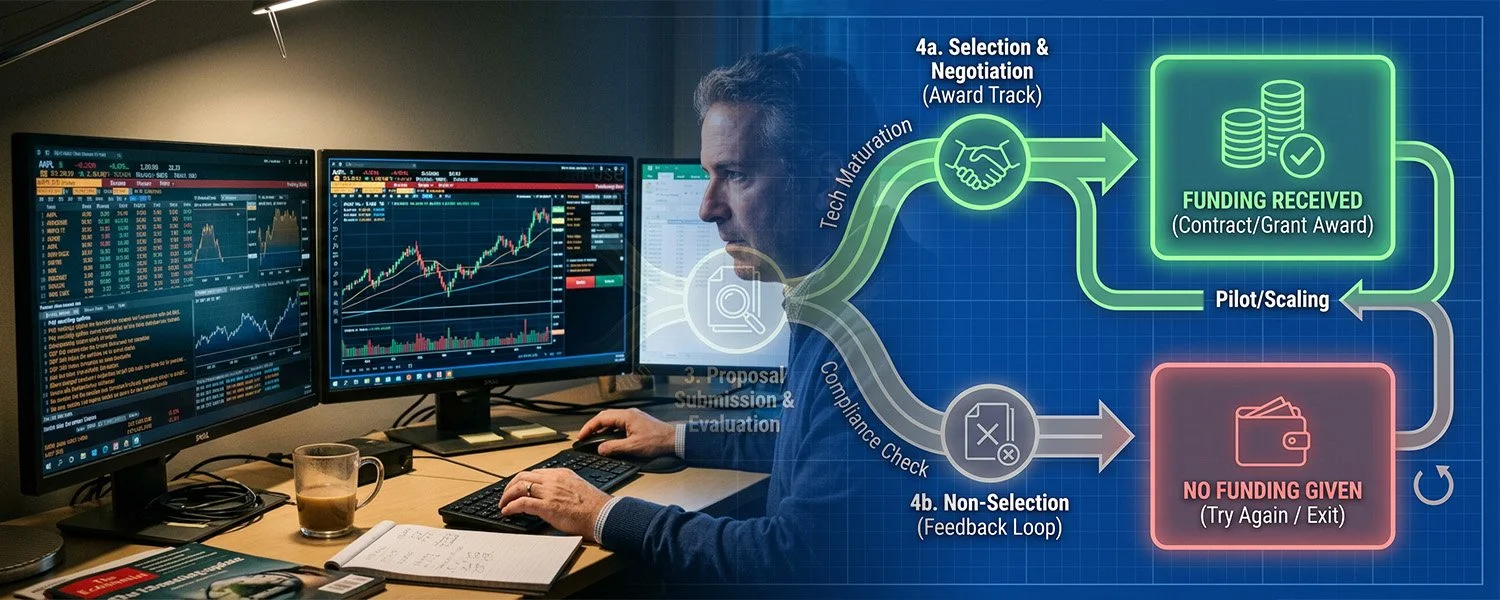
By Tim Chrisman, Skytop Contributing Author and Host of “The Case for Space”, SkytopTV Talk Show Series / August 14, 2026
Tim Chrisman is a space policy and geopolitics expert who writes extensively about the future of humanity in space. He leads the Foundation for the Future, a nonprofit based in Washington, D.C. which is leading the policy conversation around space infrastructure. Tim founded the Association for Space Finance, the industry association representing space investors, and whose membership ranges from small family offices to Barclays Investment Bank.
Tim is a former Army officer, who spent nearly a decade leading intelligence teams in combat and special operations units through five deployments to Iraq and Afghanistan. After his military service, Tim was selected to be a special advisor to the Chairman of the Joint Chiefs of Staff before joining the Central Intelligence Agency. He held multiple assignments at the Agency, including with the Directorate of Operations and Directorate of Analysis, culminating in a role supporting the National Space Council.
Tim studied at American University where he earned his Masters in International Relations and Affairs; the second of his two master’s degrees (the other is in Intelligence Studies). Tim is the author of the book Humanity in Space and is a prolific writer about the expanse of our civilization in space.
Record capital is flowing into dual-use companies on the premise that government interest reflects real demand. Boards need a way to test that premise.
Venture investors put more than $14.6 billion into defense, national security, and law enforcement startups during the first five months of 2026, according to Crunchbase data. That already exceeds the $9.6 billion raised during all of 2025, itself a record year. Much of the investment case assumes that government interest in a company’s technology is evidence of government demand. Few boards test that assumption directly.
A familiar board slide says the Pentagon is interested. Management has met with a service innovation unit, answered a request for information, been invited to demonstrate at an exercise, and received a small prototype award. The slide calls all of it “Government Traction.” Every item may be accurate. The board still does not know how much traction the company has. Government activity covers several different states. Treating every positive interaction as demand can distort engineering priorities, capital allocation, and management credibility just as investors are most willing to believe the story.
Government Activity Falls into Five States
Government activity falls into five observable states: access, interest, selection or current-stage award, successful performance, and funded transition. Access means the company can reach an operator, office, event, or acquisition team. Interest means a government actor has responded positively or requested information without selecting the company or committing funds. Selection or current-stage award means the government either chose the company for a defined next step or awarded funding through the current instrument. Examples include a demonstration slot, prize down-select, or prototype award.
Successful performance means the company completed that selected or funded stage under the conditions set for that stage. Funded transition means an identifiable government office has funded the next action or made a documented commitment to do so. The office, instrument, money, and decision must all be identifiable. A stated possibility of follow-on work does not qualify.
None of these states guarantees the next. Access can remain access for years. Selection can end without successful performance, and successful performance can end without funded transition. A traction event is an observed government action that reduces uncertainty around the company’s next decision. Access and interest are worth reporting to the board. Neither is a traction event on its own.
Trouble starts when management collapses all five states into “momentum.” An invitation to demonstrate is not completed performance. A finalist position is not a prize win. A technical selection is not a signed agreement, and a signed agreement does not necessarily obligate funds. A demonstration proves only what the event measured.
Track the Capital Consequence Separately
Government results can matter to investors before revenue arrives. An independently observed demonstration can show that the product works in a relevant setting and that the team executes under external scrutiny. That can strengthen diligence. It can still change nothing if there is no money, no transition owner, and no evidence the result can be repeated.
Boards should record the capital consequence separately from the government state. Use one of four labels: no observed effect, an additional diligence signal, support for a financing decision, or financing completed. The government state does not dictate the capital label. A funded prototype can have no observed financing effect. A funded transition can support a financing decision without causing it.
Do not infer one from the other. An award does not prove financing. A demonstration does not prove transition. A prize does not prove product-market fit. A senior officer’s enthusiasm does not establish budget authority. The board needs two answers in the same meeting: what the government did, and what changed in the company’s capital position because of it. Defense-technology valuations are rising round after round this year. Merging those answers lets a company tell itself a financing story the evidence does not support.
Funded Transition Requires Five Conditions
Government interest becomes financially meaningful only when five conditions support a funded transition: a real problem owner, current money, a usable instrument, a decision-linked evidence event, and a funded-transition owner.
The problem owner is the unit, command, or program office closest to the operational consequence. That actor can explain what fails today and what level of performance would change the outcome. Current money means funds available for the next action now, not a future budget plan. A usable instrument means an office has authority to place an agreement the company can perform under. A decision-linked evidence event is a test, demonstration, or milestone whose result determines the government’s next action. The funded-transition owner is the person or office responsible for that next decision and the money behind it.
An enthusiastic uniformed user does not establish those conditions. Neither does an innovation-office logo, prototype authority, demonstration invitation, or theoretical future budget. Any one may matter. None satisfies all five conditions.
Government pursuits consume engineering capacity, integration work, certifications, security preparation, test assets, data-rights decisions, executive attention, and working capital. The board’s question is not whether the government is interested. It is what the company must spend to reach a specific government decision and what follows if the company succeeds. Management should also be able to name the fact that would end the pursuit. If it cannot, the pursuit has no budget discipline.
Government Traction Is Now a Governance Question
Boards once could leave this analysis to the business-development function. They cannot anymore. Strategically significant capabilities, from autonomy and space infrastructure to AI, now often originate in privately financed companies rather than government programs. This year’s funding surge concentrates more of that capability in fewer, larger firms. When one of those firms misreads its government position, the mistake distorts capital requirements, hiring plans, production decisions, customer concentration, financing narratives, and management credibility. Those are board and shareholder risks, not staff details.
Skytop’s Silicon Curtain conference this September will put directors, investors, and intelligence practitioners in the same room. Governments increasingly depend on capabilities held by privately governed companies, but the processes for buying and fielding those capabilities remain uneven. A board that cannot distinguish government evidence from government theater cannot judge what that relationship is worth or how much capital to commit to it.
The United States can attract record private investment and produce world-class technology companies yet still fail to turn commercial innovation into national capability when government interest never becomes funded adoption. Procurement speed matters, but it does not decide geopolitical competition by itself. Repeated conversion failures across companies and years impose a strategic cost no financing round can offset.
The Board’s Decision Standard
When management presents a government-traction slide, the board should neither dismiss it nor celebrate it. It should ask five questions. What did the government do? What uncertainty did that action reduce? What decision comes next? Who has the authority and money to fund it? Does the expected result justify another allocation of company capital? Government interest backed by clear answers deserves investment. Interest without them deserves a smaller line on the slide, whatever the market is paying for the story this year.
I wrote Government Traction to give founders and investors a working method for answering those questions. At board level, the standard fits in one sentence: the most expensive thing in this market is a promising meeting.