
By John Grommers, Skytop Contributor and Host of “The Janus Brief”, SkytopTV Talk Show Series / November 2, 2026
John Grommers is Founder and Managing Director of Poseidon Sigma, a security consulting and services firm serving family offices and corporate clients. He is a retired CIA Senior Technical Intelligence Officer and a recipient of the Agency’s John A. McCone Award.
Technology, geopolitics, capital and social movements no longer threaten executives one at a time. They now compound — and the attack lands at the front door.
Three Doorsteps
On April 10, 2026, a man threw a Molotov cocktail at the San Francisco home of OpenAI chief executive Sam Altman. Prosecutors charged him with attempted murder and arson; according to CNBC, he had warned of humanity’s extinction from artificial intelligence. Sixteen months earlier, UnitedHealthcare chief executive Brian Thompson was shot dead on a Manhattan sidewalk on his way to an investor conference, in a killing that turned public anger at health insurers into an attack on one man. In July 2025, a gunman with a grievance against the National Football League killed four people at 345 Park Avenue. Among them was Blackstone executive Wesley LePatner, who worked in the same tower and had no connection to the gunman’s target.
Read separately, these are three different stories: a fear of technology, a grievance against an industry, an obsession with an institution. Taken together, they describe one pattern. In each case, forces far removed from the executive became violence at an ordinary moment — a front door, a hotel sidewalk, an office building lobby. None of these attacks began with the executive but all of them ended there.
From Collision to Convergence
Skytop Media Group’s Capitalism Today has a name for the environment that produces this pattern. Its Q3 2026 briefing calls the present the Collision Era, in which disruption arrives “not as a single shock but as a compound event.” What emerges from those collisions it calls convergence: the point at which formerly separate forces — technology, geopolitics, investor values, capital flows, economic cycles and social movements — “stop acting independently and begin reinforcing one another.” The framework identifies ten collision zones and three consequences for leaders: amplified risk, compressed time and reshaped strategy.
The framework was written for boards and strategists. It applies with more force to the people responsible for keeping executives safe, because each of the three consequences has a protective equivalent.
Amplified risk. One corporate decision now creates exposure in several domains at once: physical, digital, reputational and geopolitical.
Compressed time. A grievance can move from a social media post to a doorstep in days, and a cloned voice can redirect a motorcade in minutes.
Reshaped strategy. A protective model organized around proximity — guarding the principal at events and on trips — no longer covers where the danger is assembled.
Corporate security is still largely run in silos, the main two of which are physical and cyber. Physical can encompass gates, guards and guns: access and entry control systems and personnel, a close-protection detail for the "C" suite with residential security, events and travel, and perhaps a travel-risk assessment vendor for overseas trips. Marketing may supervise a communications team to monitor and guard the company's reputation and public image, and the CISO will run a cyber team for networks, devices and accounts. Each watches its own domain. Convergence means the threat to the principal is built across all of them at once, and no single silo sees it whole.
Two Meanings of Convergence
Security professionals will likely notice that Skytop has borrowed a word our field has used for the better part of two decades. In corporate security, convergence has a specific meaning: the integration of physical security and cybersecurity — often with business continuity and crisis management — under common governance, shared intelligence and coordinated response. The case for it is practical. Badge systems, cameras, door controllers and building-management systems now sit on corporate networks; a cyber intrusion can unlock a door, and a stolen laptop or a tailgater in the lobby can provide physical access to a network.
Organizations have answered that case in different ways. Some keep a chief security officer for physical security and a separate chief information security officer for cyber. Others now place both domains under a single executive. Many more sit in between, with distinct leaders working together on joint risk committees, shared operations centers and common incident playbooks. Full structural merger remains the minority model: an ASIS Foundation study of more than 1,000 security leaders found only about one-fifth of organizations fully converged, and the 2026 Annual Chief Security Officer Survey, sponsored by ASIS International, describes a shift toward specialization joined by formal collaboration rather than toward a single security chief.
The two meanings are connected, and the connection is the argument of this article. Skytop’s convergence describes the threat environment: forces that once acted separately now compound. Security convergence describes the response: functions that once operated separately must now act as one. The first is making the second unavoidable — and it is pushing convergence well beyond the familiar pairing of physical and cyber, into protective intelligence, travel risk, insider risk, communications and legal. For executive protection, the question is no longer whether to converge but how. An organization can keep two chiefs and still converge in practice; what it cannot do any longer is protect a principal with teams that do not share a single picture of the threat.
Boards Are Already Paying For The Change
Spending has moved faster than most protective programs. Equilar’s review of S&P 500 proxy filings found that 37.8 percent of companies provided security perquisites to at least some executives in 2025, up from 23.6 percent in 2021, while the median value more than doubled, from $55,228 to $130,468 (Figure 1). Pay Governance, analyzing proxies filed through mid-June 2026, found that the share of S&P 500 companies reporting personal security for the CEO rose from 35 percent to 54 percent in a single year, and that about 47 percent now extend it to at least one other named executive, up from fewer than 20 percent. The same analysis notes companies adding cybersecurity monitoring, identity-theft protection and home network security to the package: a quiet admission that the executive’s attack surface is no longer only physical.
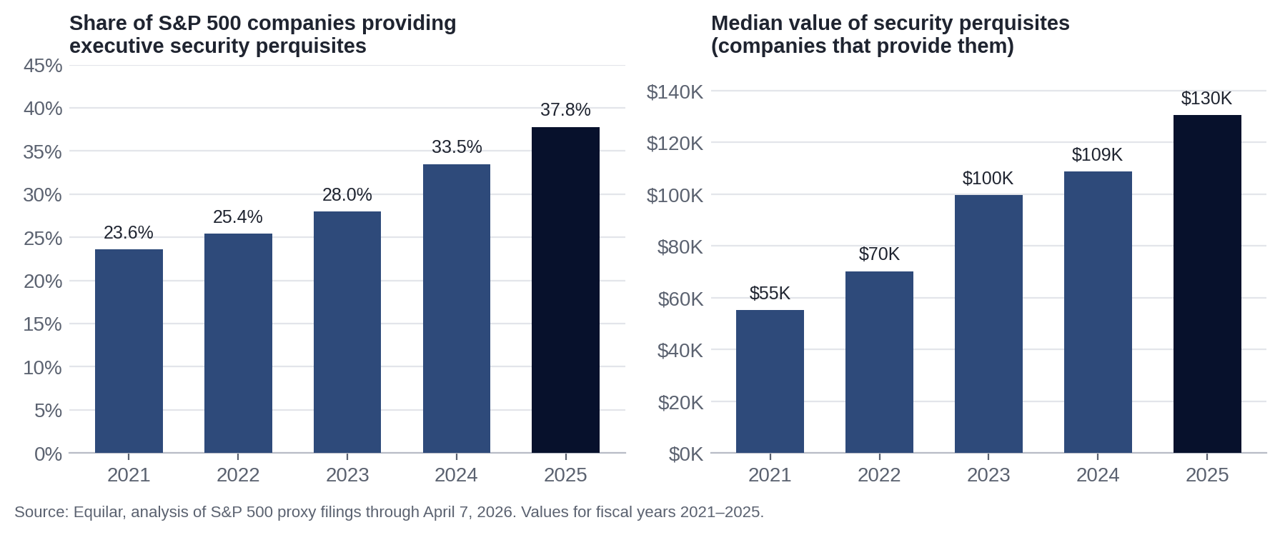
Figure 1. Executive security perquisites at S&P 500 companies, fiscal years 2021–2025. Source: Equilar.
The digital side of that surface is growing fastest. In Pindrop’s 2026 Deepfake Readiness Index, published in September, nearly three-quarters of security leaders said they had encountered or suspected a deepfake attack in the past year, yet only 10 percent said their organizations had purpose-built defenses. Three-quarters said deepfakes would become a boardroom priority only after one of their own leaders had been fooled or impersonated. Outtake’s July 2026 executive-impersonation benchmark found that 53 percent of organizations had an executive or employee impersonated.
Five Ways Convergence Reaches The Principal
Mapped onto executive protection, Capitalism Today’s ten themes resolve into five vectors of risk (Figure 2).
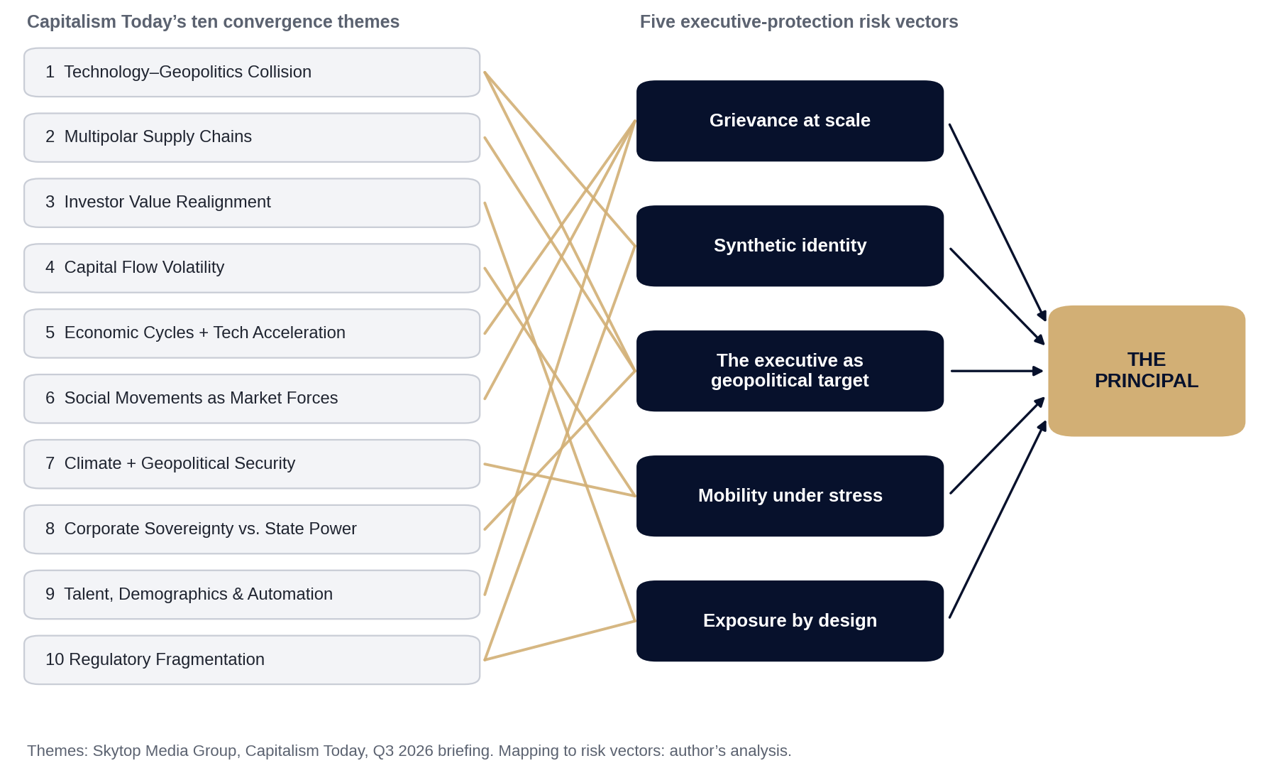
Figure 2. How the ten convergence themes map onto executive-protection risk. Themes: Skytop Media Group, Capitalism Today. Mapping: author’s analysis.
1. Grievance at Scale
When recession meets automation, a layoff stops being an impersonal business cycle and acquires a face: the executive who announced the AI strategy. Culture-war campaigns turn brand decisions into personal targets. The attack on Altman’s home shows how a diffuse fear of technology can be pinned on one person. The pattern is already reaching physical infrastructure. In August 2026, city leaders in Salix, Iowa, cancelled a council meeting after threatening messages over a proposed data center, and police in Marshall, Michigan, investigated what they called credible death threats against council members in a similar dispute. Today the targets are local officials. The executives who sign the leases or lead the companies are one step away.
2. Synthetic Identity
Generative AI has made the principal’s voice and face a forgeable credential. The familiar risk is fraud: a cloned chief executive authorizing a wire transfer. The less familiar risk is operational. A convincing voice note can change a pickup point, cancel an advance or send a driver to the wrong door. Protective details run on trust in the principal’s instructions, and that trust can now be counterfeited at almost no cost.
3. The Executive as Geopolitical Target
When corporations become geopolitical actors, their leaders inherit geopolitical enemies. In August 2026, German authorities disrupted a plot against Stefan Thumann, head of the drone manufacturer Donaustahl; according to TorchStone Global’s monthly executive-protection report, the operatives acted on behalf of a Russian intelligence service and had surveillance on him dating back to December 2025. Executives in drones, semiconductors, artificial intelligence, energy and critical minerals should assume that hostile states now regard them as part of an adversary’s supply chain.
4. Mobility Under Stress
Extreme weather, contested airspace and sudden swings in capital flows now disrupt travel with less warning. A hurricane, a regional conflict or a coup can strand a principal far from the plan. Evacuation planning that was once reserved for high-risk countries becomes a standard part of routine travel.
5. Exposure By Design
Proxy rules require companies to disclose what they spend protecting executives, and activists, journalists and savvy adversaries read those disclosures. Universal proxy cards make individual directors campaign targets. Meanwhile the law is a patchwork. Protection for a home address that exists in one state does not exist in the next, and what a protective team may lawfully do about a drone over a residence varies sharply by country; in the United States, active counter-drone measures remain largely reserved to federal authorities. A protective program that is lawful in New York may not be lawful in Frankfurt.
The Next 18 months — And The Next Five Years
Convergence is not a forecast; it is already visible in the incident record. The question for protective programs is how fast it compounds (Figure 3).
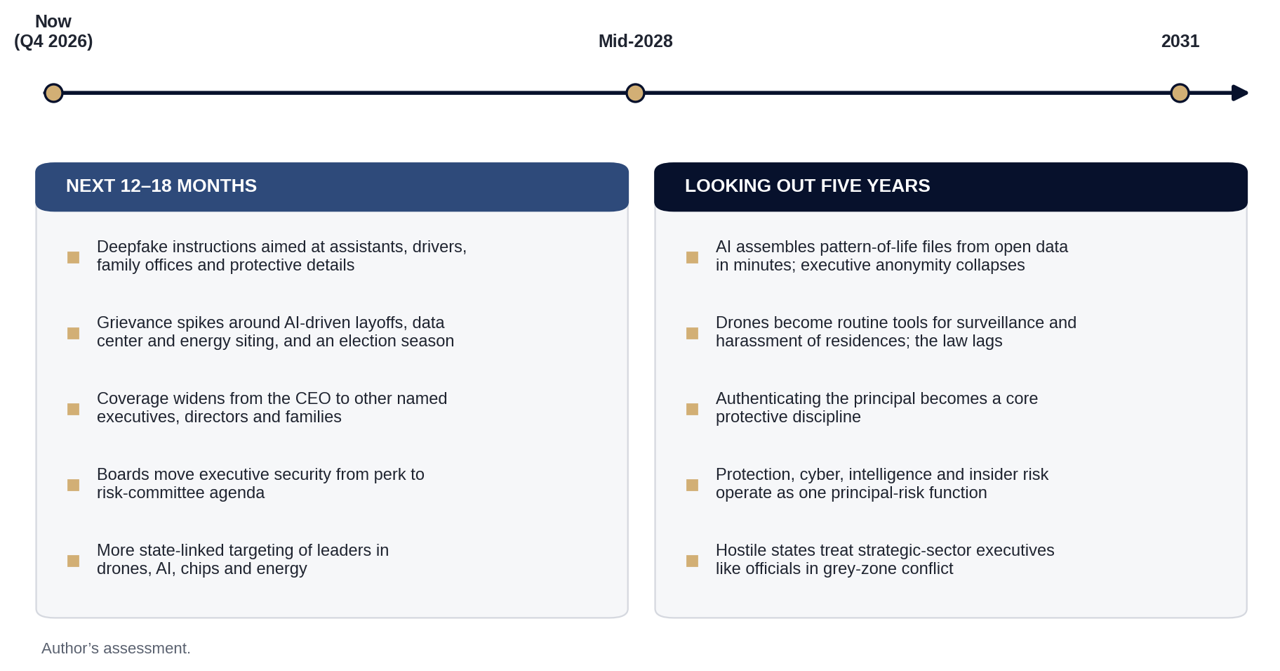
Figure 3. The convergence horizon for executive protection. Author’s assessment.
Through Early 2028
Impersonation becomes operational. Expect deepfake instructions aimed less at finance teams and more at the people around the principal: assistants, drivers, family offices and protective details.
Grievance follows the corporate calendar. AI-driven restructuring, data center and energy siting, and pricing decisions in health care and housing will generate spikes in hostile attention, amplified by the U.S. midterm election season.
Coverage widens. The Pay Governance data already shows protection extending from the CEO to other named executives; directors and family members are next.
Boards take ownership. Executive security moves from a perquisite line in the proxy to the risk committee’s agenda, with metrics and accountability.
State-linked targeting grows, particularly against leaders of companies supplying drones, chips, energy and defense technology in Europe.
Looking Out to 2031
Anonymity collapses. AI agents will assemble a pattern-of-life file from property records, social posts, flight trackers and photographs in minutes. That work once took a professional surveillance team weeks.
Drones become routine. Cheap, capable drones will be used to watch and harass residences long before the law gives private protective teams the tools to respond.
Authentication becomes a protective discipline. Verified channels for the principal’s instructions will be as standard as an armored vehicle.
Security convergence goes beyond physical and cyber. Whether under one executive or several, close protection, protective intelligence, cyber, insider risk and crisis management will operate as a single principal-risk function reporting to the board.
Executives are treated like officials. In grey-zone conflict, hostile states will treat leaders of strategic companies much as they treat government officials.
Why The Traditional Model Falls Short
Traditional executive protection is organized around proximity: the closer the threat, the more resources it receives. Convergence moves the decisive phase of an attack away from the principal — into data, grievance and planning that happen weeks before anyone approaches the door. Thompson, Altman and LePatner were attacked during routine moments, not at high-profile events.
Research on targeted violence, including the U.S. Secret Service’s, consistently finds that nearly all attackers plan before they act and often signal their intent. That pre-attack phase is where they are most detectable. Convergence makes it longer, more digital and more widely distributed, which means it can be seen only by a program that looks across domains rather than within them. That is security convergence in its most practical form.
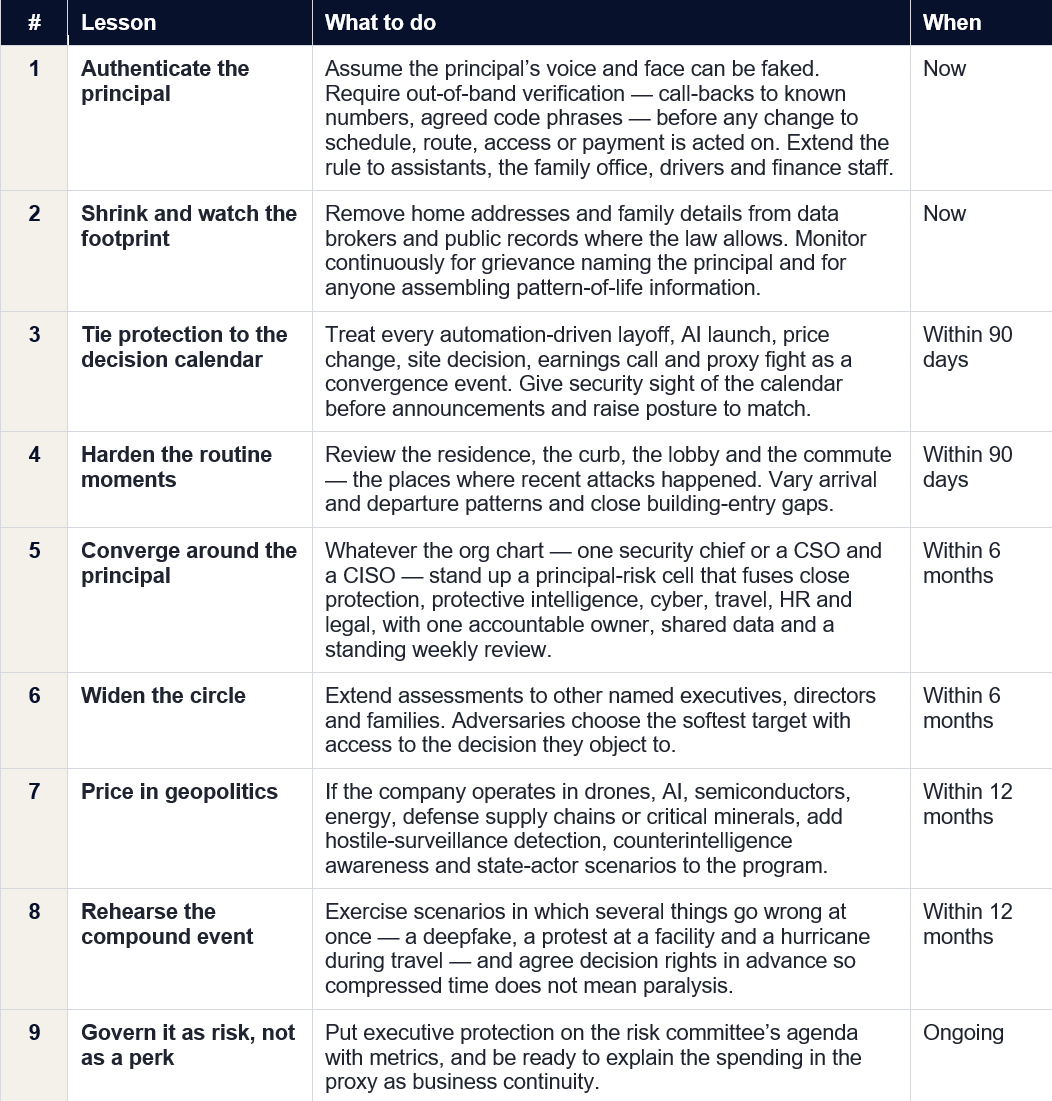
Lessons Learned: Applying Convergence to C-Suite Protection
The lessons below are ordered by urgency. The first three cost little and can begin this week; the rest build the program convergence demands.
The Face of The Company
The executive has always been the public face of the company. Convergence makes that face the place where the company’s technological, political and social collisions land. Protective programs that still keep physical, digital and geopolitical risk in separate files will keep learning about convergence the hard way: after the fact, on a sidewalk.