
Calm of Command: Eisenhower’s Principles for Turbulent Times
By Arthur Kohn, Skytop Contributor / May 20, 2026
Arthur Kohn has practiced law since 1986, focusing on compensation and benefits matters, including executive compensation, pension compliance and investment, employment law, corporate governance and related matters. In 2012, he was named by the National Association of Corporate Directors’ Directorship magazine to the Directorship 100 list, which seeks to identify “the most influential people in the boardroom community, including directors, corporate governance experts, journalists, regulators, academics and counselors.” In 2021, he was appointed as a fellow to the American College of Governance Counselors.
Arthur is an adjunct professor at New York University School of Law, which he has taught the Taxation of Executive Compensation since 2009. He frequently speaks and writes about executive compensation, taxation and corporate governance matters. He repeatedly has been recognized for his work by the business and legal press, including Best Lawyers, Chambers USA, The Legal 500, Super Lawyers of New York and others.
Arthur received a B.A. from Columbia University and a J.D. from Columbia Law School, where he was admitted into the Accelerated Interdisciplinary Legal Education program, was appointed a Harlan Fiske Stone Scholar and received Phi Beta Kappa honors.
America today is consumed with questions about the apparently evolving world order, which can affect not just politics, both global and local, but also culture, war and peace, obviously, individual lives and, not least, the business of business. Who are we and what is our proper role in the world? How open and closed should we be to the rest of the world, both on a grand geopolitical scale and on the scale of a child who happens to have been born here to immigrant parents?
In “How Ike Led, the Principles Behind Eisenhower’s Biggest Decisions”, published in 2020, by Susan Eisenhower, the historian granddaughter of President Dwight D. Eisenhower, we are offered some lessons in how to address, on a principled basis, the questions raised by the challenges of needing to navigate the inconsistencies, stresses and conflicts inherent in global leadership. The book presumes that there is value in principles that guide leadership, rather than just herky-jerky reactions. It’s an argument that hardly needs to be made explicitly.
Here you have the logic and reason behind the principal decisions made by a man who had a lot of experience with the need to carefully balance multiple interests and risks, in his full career as a military leader, including as Supreme Commander of the Allied Expeditionary Force during World War II, overseeing the D-Day landings and liberation of Western Europe, as the first Supreme Allied Commander Europe for NATO, structuring the Cold War defense of Europe, in his short but significant stint in academics, as the President of Columbia University, and in his eight years in politics as President of the United States, the first Republican one in a full generation.
Although former President Eisenhower never devoted his considerable skills and experience to running a business, Ms. Eisenhower notes in the Introduction to her book that a foundation of the principles he employed was “the mechanisms of good governance”. The book is an apt and succinct argument for attention to the elements of good corporate governance by business leaders, whose decisions, while not comparable to those faced by the former General and President, are consequential enough to matter a lot.
What we learn is that there is wisdom. The following are my principal takeaways from the fascinating stories recounted in the book.
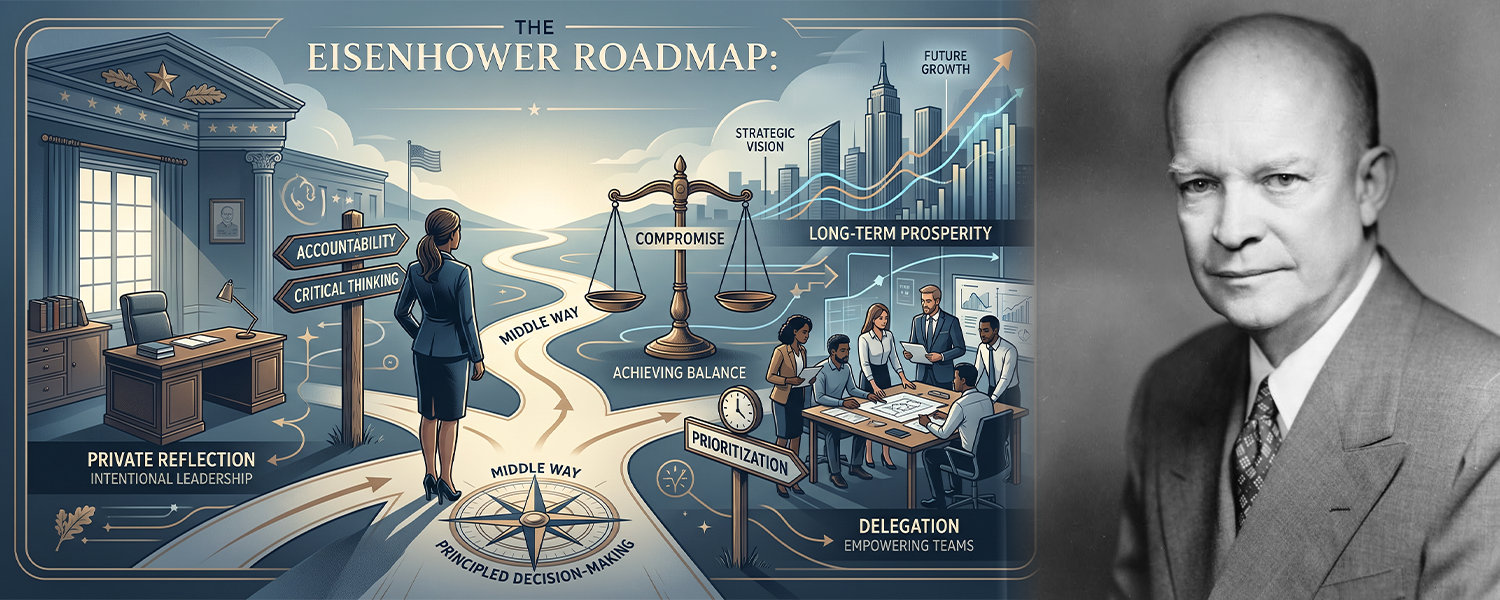
1. The “Middle Way” and the Principle of Compromise. Dwight Eisenhower’s political party affiliation was famously unknown until well into 1952, just shortly before he decided to run for the office of President. He was courted by both parties for the job. He referred to his governing philosophy as the “middle way”. The idea of capturing the political middle as a path to electoral success was not novel and is not unique, of course. The question that begs to be asked is whether the “middle way” was for him a value, a tactic or something else, and what exactly it meant.
It seems implausible that Eisenhower was politically “moderate” by disposition. Surely, the Supreme Allied Commander was not wimpishly shy of conflict. In terms of political disposition, we learn that Eisenhower’s grandfather was part of a migration of Pennsylvania Dutch pacifists who migrated to Kansas in the late 19th Century. Maybe it was their influence, or the history of the progressive Kansas GOP under which he grew up, that made Eisenhower a natural moderate. But the book details the political views of two of his siblings, who grew up in the same household. One grew into the political philosophy espoused by the hard right, another became a liberal academic. It seems that neither nature nor nurture were dispositive in shaping the former President’s views in this regard, but rather it was reason informed by lived experience.
Perhaps the “middle way” was a political philosophy. In summation at the end of her book, Ms. Eisenhower quotes the political scientist Robert Kaplan saying that “the greatest virtue in civic life – and the ultimate factor determining political stability – has always been principled moderation.” In his speeches, Eisenhower certainly used the idea of moderation, in and of itself, as a political appeal.
Another theoretical possibility is that Eisenhower saw the middle way as the easy way. But it is equally implausible to argue that the former President’s “middle way” was a product of his lack of intense devotion to furthering the best interests of his country. This is a man who spent his whole life in public service.
There is a difference between moderation and compromise, and it seems most plausible that the “middle way” was at its heart an expression of Eisenhower’s appreciation of the value of compromise in achieving goals, rather than a belief in the value of moderation in itself. Barry Goldwater’s aphorism, that “Extremism in defense of liberty is no vice. Moderation in pursuit of justice is no virtue.” has a kernel of truth to it after all. Ms. Eisenhower argues that when the former President thought that liberty and justice were at issue, her grandfather was no moderate. The most interesting, and somewhat challenging, illustration of the point arises in her telling of the story of how President Eisenhower dealt with Senator Joe McCarthy’s red baiting.
Goldwater, of course, was himself highly critical of Eisenhower, and had very different perspectives and prescriptions on the subject of domestic politics. Interestingly, when it came to foreign policy, Goldwater was publicly deferential. In campaigning during the 1964 election, “Mr. Goldwater said that his ideas for a successful foreign policy corresponded generally to the policy of the Eisenhower Administration. . . . You must always, show yourself ready to throw in everything if you want to be respected and you are fighting for peace,” Goldwater is quoted as saying. “The only person respected is the one who clearly says—when necessary—that he is determined to go to the utmost.” So, Goldwater apparently didn’t see Eisenhower as a moderate in the foreign sphere, and how could he after Eisenhower’s successful career as a military man?
But it is also implausible that Goldwater’s criticism of Eisenhower turned only the distinction between domestic and foreign issues. Much more likely, the difference between the two men was about the “when necessary”. Goldwater seemed to find it almost always so. For Eisenhower, not so much. He saw the value of compromise frequently, as compared to throwing it all in. That principle held even in regard to domestic battles. However, as when the former President called in the 101st Airborne to protect the Little Rock nine, Ms. Eisenhower illustrated that her grandfather did agree that sometimes extreme measures were necessary to protect freedom.
What the former President seemed to understand better than most was the value of compromise, as a principle. Ms. Eisenhower makes a strong case that for him the value was borne of military experience. She recounts General Eisenhower’s debates with Churchill about the approach to D-Day, in which Eisenhower insisted on fundamental strategic matters, but compromised on other matters. But the principle of compromise was not only about negotiating tactics. Ms. Eisenhower notes that her grandfather’s “relationship with others centered on what I regard as his genius. . . . He was a master at knowing when to suppress his ego and when to deploy it. . . . He was honed in the art of, strategically used, of standing back and allowing others to win a few, while saving himself for the moment of greatest impact.” This is more fundamental than compromise in the sense of cutting the best deal in a deal. It is the art of leadership.
Ms. Eisenhower cites as an example her grandfather’s strategic decision to allow the French to liberate their own city of Paris. “A man of unchecked ego would have relished the thought of his ceremonial demonstration of his own personal and military power. . . . Eisenhower’s support of Gen. Charles de Gaulle, over the wishes of his boss, President Roosevelt, paid dividends” in important ways down the road. He didn’t come out as a loser because of his restraint.
Interestingly particularly in an age of populist sentiments, Eisenhower’s middle way approach was criticized, by William F. Buckley, as being too populist. This criticism may reflect more on Buckley than on anything else. To the extent that it reflects any reality, it may suggest the realization that most don’t have the luxury of extremism in the conduct of our daily lives. Compromise is a necessary way of life. Ms. Eisenhower extols the former President’s fondness for the enlisted soldiers and others who served well under him in the chain of command. So, there may be something to Buckley’s observation, but not his view that Eisenhower’s election in 1952 “proved . . . that people could not be trusted to choose what was right”.
In sum, the “middle way” for Eisenhower seems to be mostly about the value of compromise, in and of itself, as a leadership principle.
2. The Privacy Principle and the Thrill of Speed. Ms. Eisenhower makes much of her grandfather’s penchant for private thought. She assesses that many commentators mistook his desire for privacy as a sign that Eisenhower did not face much inner struggle. She only mentions Richard Nixon, Eisenhower’s Vice President for eight years of course, a few times in the book, but one of them is to quote from him about Eisenhower’s preference to make decisions in the calm environment of private thought, recounting from an interview of Nixon in the 1990s his recollection that “Ike never made an important decision in front of others. He would go into his office alone and think.”
There is a propensity today for leaders to be much more generous with their thoughts. Some credit this as a helpful nod to transparency and openness. The ease of mass communication today, however, frequently suggests the oft-noted inclination of many to let their mouth run before they have had a full opportunity to get their brains in gear.
In the business world, the closely-related desire to appear hyper-responsive 24 hours a day, 7 days a week, often by using the means of modern technology to be able to fashion a response to any inquiry or request at the speed of electrons, speaks to this reflexivity. Many recognize the hazards of the approach, but few claim that there is a way to solve the problem. Ms. Eisenhower notes that sometimes her grandfather “would assess a subordinate’s efficiency with warnings if the man had a tendency to keep track of privileges or had a propensity to preen or look for credit”. The former President’s discipline and care in his own decision-making approach, and his recognition that efficiency may be a tell for other less-desirable traits in a subordinate, is a principle worth slow and careful consideration.
As the former President put it, “Unless circumstances and responsibility demanded an instant judgment I learned to reserve mine until the last proper moment. This was not always popular.”
3. Followers Disguised as Leaders. Ms. Eisenhauer posits that “it is ironic, perhaps, that many great, victorious military commanders in our history – Civil War general Ulysses S. Grant; Gen. John Pershing, World War I commander of U.S. forces; and Dwight Eisenhower, World War II supreme Allied commander in Europe – graduated from West Point well below the top of their classes.” What explains it? “In their cases their poor disciplinary performance may have been less about failure than an indication that their personalities questioned the importance and utility of everything. They were not “company men” or “insiders”.”
She emphasizes the point by noting the former President’s attachment to the ideals of “selflessness and self-sacrifice”. She says that “this commitment to a higher cause did not stop Eisenhower, however, from questioning the reasons why things were done a certain way.”
There is an art to being a contrarian, outsider and creative thinker. Crossing the street alone is frequently not only dangerous but also ill-advised. But top down organizations that stifle the creative sorts suffer also. This issue will be exacerbated as computer software will increasingly guide the masses about how to think, based only on how the masses think. The use of artificial intelligence is the ultimate tool of followers, like those who look around to see who else has raised their hand in a question at a Presidential debate, or those who always tell their supervisors what they want to hear. We all await the efficiency enhancements promised by artificial intelligence, but in this as in most other things the challenge will be to find and operationalize the right balance in an organization’s culture.
Ms. Eisenhower illustrates that challenge can be met, in a story she tells about a pivotal episode in Eisenhower’s early army career. A few years into his career, Eisenhower apparently was nearly dismissed for having written a contrarian article about tank doctrine in a military journal, showing independence of thought in what is perhaps the ultimate top down organization. Apparently “none of his superiors appreciated a freethinker”. This is understandable in an enterprise in which lives depend on following orders. We all know, but sometimes have a need to relearn, that even in that context just following orders is not always a defense. How much more so in a business organization should creative thought, at the right time and in the right way, be encouraged, welcomed and applauded?
4. Making the Pie Bigger. Probably the most psychologically difficult of Eisenhower’s career challenges were the decisions about the treatment of his vanquished enemies in the aftermath of World War II. Ms. Eisenhower describes in detail his reaction to the horrors of the holocaust he witnessed first hand, and to his efforts to see to it that war criminals were justly punished. She makes clear that his guiding principle in dealing with these issues was not retribution.
Instead, the guiding principle was a focus on the country’s long-term interest. It bears remembering, as Ms. Eisenhower notes, that “in Britain alone the government was only able to terminate rationing in 1954, nine years after the end of the war.” One wonders how our culture today would deal with that sort of sacrifice. The former President articulated the challenge, writing that “although everyone believes in cooperation (the single key) as a principle, no one is ready to abandon the immediate advantage or position in practicing cooperation.”
Antitrust law being what it is, the issue of cooperation is not fundamental to microeconomics, but it is fundamental to macroeconomics. In the business context, it presents itself most clearly in today’s environment in the issues about the rule of law and the regulatory state, as well as inequality. These are issues that require a wise balance between the good of a few and the good of the whole.
In these regards, Ms. Eisenhower recounts that her grandfather, in the second year of his first term, when both houses of Congress were in Republican hands, expanded the social security safety net. The former President defended himself against the criticism from his own party that followed by talking about steps taken to unleash the post-war economy. His initiative to build the Interstate Highway System was perhaps the most enduring and well-known of those. Similarly, he argued that management and labor had a commonality of interests – growing the economy – and that the business community, still largely blamed for the Great Depression, needed to be brought back to the table. While on the one hand he credited American business for powering his army, on the other hand during his time in office the top marginal tax rate for earned income was 91% (ninety-one percent).
The former President summed up the issue himself as follows:
[The Middle Way is] progress down the center, even though there the context is hottest, the progress sometimes discouragingly slow… [It is a commitment to the proposition that] no part of our society may prosper permanently except as the whole of America shall prosper”.
5. The Guts to Delegate. Can and should the chief executive centralize all authority in himself? This is a challenge in all large organizations. President Eisenhower responded to the question by quoting the nineteenth century German general Helmuth von Moltke, who said: “Centralization is the refuge of fear.”
The conundrum, of course, is that the chief executive in theory has the best knowledge and skills to make all decisions within the organization. President Eisenhower’s first Attorney General, Herbert Brownell, quipped that Eisenhower “may not have learned too much” from his cabinet. “In the two-thirds of his job dealing with foreign and military affairs he knew more that all of us put together.” On the other hand, no large organization can function well with a chief executive who arrogates to himself the responsibility for dealing with the day-to-day details of operations much less the petty concerns that inevitably arise.
Eisenhower believed what seems today obvious, that accountability is the key and a systemic, organized approach to setting policy for subordinates to follow was necessary. Some big organizations and leaders get it very wrong.
What I appreciated most in regard to this issue is not Ms. Eisenhower’s note that her grandfather chaired 329 of the 366 meetings of his National Security Council over eight years. It’s an impressive statistic to be sure, which she uses to lob a criticism at the Kennedy administration for its different approach, especially in the time leading up to the Bay of Pigs fiasco. Instead, I was most impressed by another point.
In an endnote to the book Ms. Eisenhower recounts that those NSC meetings were minuted, because “Eisenhower wanted to be sure that what was said as part of a brainstorming session was not accidentally mistaken for a decision”. Most business lawyers today will tell you that they see that issue come up all the time in sloppy emails, filled with acronyms that no one can interpret, recounting a discussion about a powerpoint that itself is laden with jargon and ambiguous bullets and graphics. What a mess! I know that doing minutes is a boring detail, a drudgery, in the world of governance, but that does not make it any less important. It’s notable that Eisenhower had a view.
6. Realism versus Liberalism. The most important foreign policy episodes during the Eisenhower administration include the Suez canal crisis and the Soviet Union’s Hungarian revolt response, both in the fall of 1956, at the time of his re-election bid (no coincidence). Ms. Eisenhower quotes a 1956 campaign speech by former President Eisenhower, just before the election, which is probably the most surprising in the book:
We cannot and will not condone armed aggression – no matter who the attacker, and no matter who the victim. We cannot – in the world any more than in our own nation – subscribe to one law of the weak, another one for the strong; one law for those opposing us, another for those allied with us. There can only be one law or there will be no peace.
The quote evokes recent debates about whether might makes right in international affairs, or as Thucydides famously put it: “you know as well as we do that right, as the world goes, is only in question between equals in power, while the strong do what they can and the weak suffer what they must.”
The question can be fairly put as to whether Eisenhower’s overall record supports the quote, or whether it was just useful campaign propaganda. The Suez and Hungary episodes surely evidence restraint, particularly in the Suez case in light of U-2 spycraft evidence that the Soviets had not built up troop positions in the canal area. But arguments can be made about other actions taken by the Eisenhower Administration in response to the Soviet threat that have a more realpolitik orientation.
It is tempting to imagine that a military leader like Eisenhower would lean towards the more power-oriented view, while acknowledging that strategic, political and other considerations in any particular episode might dictate one type of response or another.
Ms. Eisenhower clearly assess that the quote is honest, She says that restraint in Hungary was a calculation “regrettably, of realism”. As to the Suez crisis, she quotes a personal letter by Eisenhower to a childhood friend, on November 2, 1956:
I have insisted long and earnestly that you cannot resort to force in international relationships because of your fear of what might happen in the future.
She also quotes an Israeli academic, Isaac Alteras, as saying that the crisis should be seen as “part and parcel” of the Administration’s view that “the attack on Egypt was both morally and legally unjustifiable”.
As she put it in her own words, “the Suez crisis exemplified Eisenhower’s deep belief in the very nature of the allies’ relationship and the emerging world. He respected the fact that all countries have their own vital interest, but in the pursuit of peace there could not be second-class global citizens.” As to the import of the episode, she quotes the historian Michael Corda to the effect that the crisis “brought the end of Britain’s remaining pretension to independent imperial power . . . . and it speeded the end of Britain and France as colonial powers”.
* * * *
It is not possible to read “How Ike Led” without thinking about where we stand today, as the author acknowledges in her closing:
Our culture no longer understands what was deeply ingrained in Eisenhower and many of his generation. Today we seem to think that strength is derived from winning every small fight, while raising ourselves up for recognition and advancement, even if others have to be diminished in the process. This is a trend that has been under way for many decades. To Dwight D. Eisenhower the exact opposite was fundamental to his beliefs. To Ike strength came from putting his own house in order, by exercising self-discipline and by putting others first and inspiring them to take up the cause as their own. At the same time he insisted that those “who should know better” – especially those connected to him in some way – understand there are “no excuses” for such things as pettiness and self-aggrandizement. It is easy to criticize your opponents, but it takes courage to hold your closest friends and associates to an equally high standard.