
From Data to Dirt: How Collaboration Can Transform Global Farming
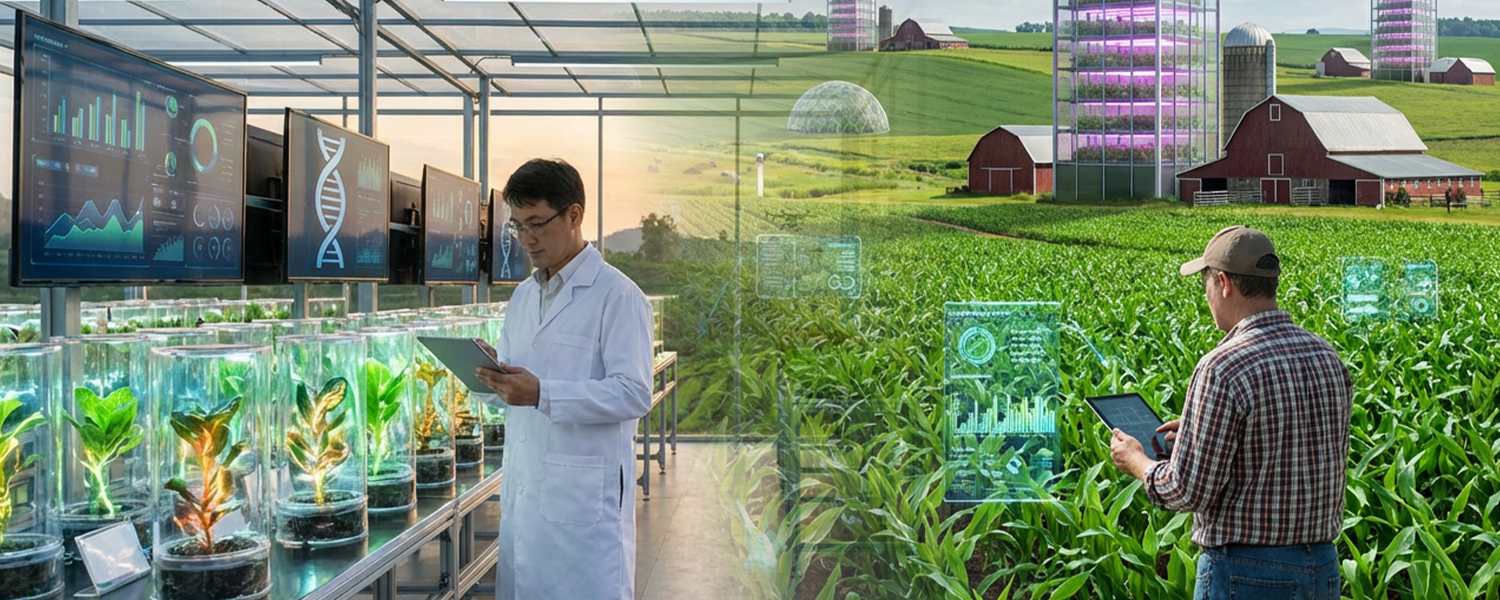
A Conversation Between John Wilson, Managing Partner, Skytop Media Group, and Suzanne Verboon, MSc, Program Manager for Agriculture, Water and Food, FME, Program Manager, NXTGEN Hightech / December 11, 2025
John Wilson: You’re a busy person—you are the Program Manager for Agriculture, Water and Food at FME and the Program Manager at NXTGEN Hightech. You must be going 24/7. What’s the connection between NXTGEN Hightech and FME? And tell me a little bit about yourself and what you do for both.
Suzanne Verboon: My background is in biotechnology rather than agriculture, though the two are closely connected. I’ve always been fascinated by how biological systems work and how technology, whether through enzymes, genetics, or new techniques, can help us to make our food system more sustainable.
At FME, I work on connecting technology with sustainable food production, while NXTGEN Hightech is a program that brings these innovations together. Both roles allow me to explore how smart use of data and technology can transform agriculture into a more future proof, integrated system.
Right now, food production is far from sustainable. We use too much land, rely heavily on fertilizers and herbicides, and compromise both the planet’s health and our own. Change is essential, and it starts with integrating food production more closely with biology itself. By collecting and applying knowledge about crops, environments, and pathogens, we can reduce unnecessary inputs and grow more wisely, using fewer resources while protecting nature.
Technologies like vertical farming show what’s possible, though I believe the future will combine high‑tech solutions with traditional soil‑based farming. Humans are biological systems too, and we benefit from the natural nutrients that come from plants grown in soil.
John Wilson: You have much technical knowledge, a biotechnological engineering degree, a passion for sustainability, and for helping people eat better. Are these drivers that motivate you?
Suzanne Verboon: Yes, absolutely. There are two main drivers for me. First, sustainability is a means, not the ultimate goal. The real goal is to ensure that future generations can live with the same level of prosperity we enjoy today. But if we continue on our current path, that won’t be possible.
Second, I think we’ve become very egocentric in how we use our ecosystem. Nature is increasingly treated as something recreational—something to visit on weekends—rather than something we are fundamentally part of. The reality is simple: without nature, there is no us.
John Wilson: That resonates with me. I used to live in the country where farming was either done by families who had been at it for generations, or by former city people who wanted a different lifestyle. Some of the former city people focused on sustainability along with niche products like growing organic cucumbers and then turning them into specialty pickles that sold for a premium in high-end food stores.
Suzanne Verboon: And that’s wonderful. I strongly support people who show what food is really about. It’s essential. But if we tried to produce all our food in purely biological, small‑scale ways, it would require enormous effort and land. With a growing global population, that system alone cannot feed everyone.
That’s why we also need high‑productivity systems. The challenge is ensuring those systems are balanced with nature—so they don’t destroy rainforests, pollute oceans, or disrupt ecosystems. The question we must answer is: how do we scale food production while keeping it in harmony with the environment?
John Wilson: Yes, that is a global question. At FME and NXTGEN Hightech—do you work specifically within the Netherlands, or Europe, or is it global?
Suzanne Verboon: NXTGEN Hightech is focused on the Netherlands, but of course, the Netherlands is a small country. The solutions we develop are meant to be applied elsewhere as well. Collaboration is essential, because while we have strong expertise in technology and plant science, we cannot invent everything ourselves. We need to combine our strengths. That’s why we work closely with European partners, where there’s a lot of common ground, but also internationally, for example, with University of California, Davis. They face similar challenges, and by sharing solutions and questions, we can accelerate progress. Competing in isolation slows things down and drains resources. In this field, the market is vast, so it’s far better to collaborate, which allows bringing solutions to the market faster.
John Wilson: That’s something I’ve heard in my conversations with others; that collaboration is critical for innovation and sustainability. Without it, progress is slower and less effective. But one concern that’s been raised around collaboration is data sovereignty. If farmers, innovators, or scientists are sharing data, how do we ensure protection? Is there a risk that someone else will profit from their data?
Suzanne Verboon: That’s a very important point. Data is the foundation of innovation, but it must be handled responsibly. Farmers and innovators need to trust that their data won’t be misused or exploited. Clear agreements, transparency, and secure platforms are essential to ensure that data sharing benefits everyone involved rather than creating unfair advantages. The goal should be collective progress—using data to improve sustainability and productivity—while safeguarding ownership and rights. If we get that balance right, collaboration can truly accelerate innovation without compromising trust.
In Europe—and I think in America as well—it’s well known that there are acts in place to protect people and companies from misuse of data. In Europe, we have the Data Act, which is designed to give companies room to innovate while ensuring that farmers and individuals can use their own data for their benefit, without giving everything away.
But sharing data is ultimately about trust. You need to know what your data is being used for and agree with that purpose. In the Netherlands, we’ve created agreements between farmers and tech companies to align with the European Data Act. The goal is to build trust so farmers know their data won’t be used against them. Agriculture is already heavily monitored by governments, and farmers don’t want their data to become a liability.
It’s similar to banking in the U.S.—your bank shares certain data, and sometimes that’s useful, but you don’t want everyone to know your account details. In agriculture, people are willing to share data, but they hesitate if they don’t know what will happen with it afterward.
John Wilson: That’s a critical point. Farmers and innovators need confidence that their data won’t be weaponized against them. Without that trust, collaboration stalls. How do you see the balance evolving—between protecting data sovereignty and encouraging the kind of data sharing that drives innovation?
Suzanne Verboon: I think the balance comes from transparency and clear frameworks. Farmers and companies need to see tangible benefits from sharing data—better yields, reduced costs, more sustainable practices—while knowing their rights are protected. If we can show that data sharing leads to real improvements without hidden risks, trust will grow. And with trust, innovation can move much faster.
John Wilson: Another topic that’s come up in conversations is the challenge of farmers with varying backgrounds and practices. Some have been farming for decades, relying on traditional methods that worked well enough, and they may not be comfortable with new technology or convinced about climate change. For smaller farmers, the upfront costs can be more than they can afford. And some feel that they aren’t tech‑savvy enough. On the other hand, large companies have the resources to buy land and invest in high‑end technology. Do you have thoughts on how innovation can be adopted or supported across this spectrum of farmers?
Suzanne Verboon: Things do change, whether we like it or not. When we were younger, there wasn’t even internet, and now it’s part of everyday life. Agriculture is no different, change will come, and those who resist it will eventually have to adapt, because otherwise their jobs or methods will simply become obsolete.
In the Netherlands and across Europe, most farmers already recognize that technology is reshaping their work. Many farms are family‑run, and they’ve seen change across generations—from horses to tractors, and now smartphones are used to check the weather. So, it’s not that farmers reject technology outright; it’s more about whether the technology is practical and applicable to their daily operations.
Some innovations truly transform what’s possible. For example, the Netherlands once couldn’t grow tomatoes because of the climate. Then we developed greenhouses, and today we’re global leaders in tomato production. That’s the power of technology—it can completely change the landscape. What feels “normal” now was once impossible. Farming will continue to evolve in the same way.
John Wilson: How can innovation in farming be successfully adopted by farmers?
Suzanne Verboon: We need to connect with all farmers. The innovations must meet their production needs. This ongoing transition takes time, and it will progress more quickly if farmers recognize the necessity and society is willing to bear the additional costs required to make this shift possible.
Many farmers already experience declining soil fertility, increasing challenges with plant health, and heightened vulnerability to extreme weather conditions due to climate change. They understand the need for new methods of food production. As a society, we must be prepared to pay the price for the transition to sustainable produced food. If we do not invest now, future generations will have to pay. If we choose to innovate, we choose for our own health and prosperity for future generations.
John Wilson: It sounds like the real challenge is not just whether robotics or automation can replace human labor, but how we measure the value of those innovations. If we only look at this narrowly, we miss the broader benefits—like healthier food, safer working conditions, and more sustainable practices. How do you think we can shift the mindset so that farmers, companies, and policymakers see technology bringing broader benefits?
Suzanne Verboon: I think it starts with redefining what “value” means in agriculture. Financial return is important, of course, but it shouldn’t be the only measure. Technology can reduce pesticide use, improve soil health, and create safer environments for workers. Those benefits may not show up immediately on a balance sheet, but they matter enormously for long‑term prosperity.
We need policies and incentives that recognize these broader outcomes. If governments and markets reward sustainable practices—whether through subsidies, certifications, or consumer demand—then farmers and companies will see that investing in technology pays off in multiple ways. And culturally, we need to emphasize that farming isn’t just about producing food cheaply; it’s about producing food responsibly, in a way that supports both people and the planet.
John Wilson: That’s a powerful way to frame it—technology as a tool for resilience and responsibility, not just efficiency.
John Wilson: That’s a helpful distinction. So NXTGEN Hightech is more of a programmatic driver, while FME acts as a connector within the Dutch ecosystem.
It sounds like you’re positioning agriculture as one of several strategic application areas where technology can make a real impact. How do you see this collaboration shaping the future of agri‑innovation in the Netherlands and beyond?
Suzanne Verboon: The strength of NXTGEN Hightech lies in bringing together existing knowledge and technological capabilities and then accelerating innovation in areas where the Netherlands already has a strong position. Agriculture is one of those areas, but it’s not the only one. The idea is to use our expertise to create solutions that are scalable and relevant internationally.
FME’s role is to connect the technological sector with these application areas, ensuring that companies, researchers, and policymakers work together rather than in silos. We don’t aim to lead the ecosystem, but to guide and strengthen it—helping Dutch industry remain competitive while also contributing to sustainability goals.
By focusing on agriculture, we’re addressing a sector that is both vital to the economy and central to environmental challenges. If we can show how technology can make farming more efficient, sustainable, and resilient, then we’re not only supporting Dutch farmers but also creating models that can be applied globally.
John Wilson: It’s about building bridges—between technology and agriculture, between local expertise and global application, and between economic growth and sustainability.
Suzanne Verboon: Yes, that’s exactly it. Collaboration and integration are the keys. If we succeed, agriculture won’t just be an industry—it will be a showcase of how technology can serve people, the planet, and prosperity all at once.
John Wilson: Having one unified voice gives you credibility and authority when speaking to policymakers, and it ensures that the needs of different sectors are represented collectively. But I imagine that it also requires a lot of coordination. How do you balance the diversity of interests across sectors that FME works in—agri‑food, MedTech, energy, semiconductors—while still presenting that unified message?
Suzanne Verboon: It’s definitely a challenge, but it’s also where strength lies. Each sector has its own priorities, but the underlying themes—innovation, sustainability, intellectual property, collaboration—are shared. By focusing on those commonalities, we can align our messaging and make sure that policymakers understand the broader picture.
We don’t try to erase the differences between sectors; instead, we highlight how they complement each other. For example, robotics is relevant in agriculture, MedTech, and manufacturing. Lightweight composites are important for vehicles, but also for energy systems. By showing these overlaps, we can demonstrate that investing in one area often benefits many others.
And when we speak with one voice, it’s not about pushing a single agenda—it’s about showing that the Netherlands has a cohesive, forward‑looking ecosystem. That makes our case stronger, both nationally and internationally.
John Wilson: It’s really about finding the common ground and building bridges across sectors, while still respecting the unique needs of each.
Suzanne Verboon: Exactly. That’s how you create momentum. When companies, researchers, and policymakers see themselves as part of a larger ecosystem, they’re more willing to collaborate. And collaboration is what accelerates innovation. And I believe there will be many new startups and collaborations emerging. Sometimes facing disruption can be a good thing—it opens new opportunities. That’s what innovation is about: creating space for new ideas and new ways forward.
John Wilson: Innovation as opportunity. Suzanne, thank you so much for sharing your insights today.
Suzanne Verboon: Thank you, John.