
Why Law Firms Need to Address AI and Cybersecurity Differently: Or Risk Irrecoverable Injury to Brand
By Chuck Brooks, Skytop Contributor & Host of “Intelligence Briefing”, SkytopTV Talk Show Series / July 20, 2026
As President of Brooks Consulting International, he is a leading voice on how AI, quantum, 5G, IoT, and blockchain are reshaping organizational risk, critical infrastructure protection, and national‑security posture.
A two‑time Presidential Appointee, Brooks served as the founding Director of Legislative Affairs at the DHS Science & Technology Directorate and previously advised Senator Arlen Specter on technology and security issues. He has briefed the G20, the Vatican, USTRANSCOM, the FBI, the National Academies, and DHS CISA on global cybersecurity challenges.
Brooks has held senior roles at General Dynamics, Xerox, Rapiscan, SRA International, and Sutherland, driving strategy, government relations, and technology commercialization. He has advised the Bill & Melinda Gates Foundation and serves on multiple boards focused on cybersecurity and digital innovation.
A prolific author with 450+ publications—including contributions to Skytop Media, Forbes, Dark Reading, The Hill, and Homeland Security Today—he writes on emerging threats, AI‑driven risks, quantum disruption, and digital resilience. He is the author of Inside Cyber: How AI, 5G, IoT, and Quantum Computing Will Transform Privacy and Our Security (Wiley).
He is an Adjunct Professor in Georgetown University’s Cyber Risk Management and Applied Intelligence programs, teaching cybersecurity, quantum, blockchain, and disruptive technologies. Georgetown recently honored him with the Tropaia Outstanding Faculty Award.
He holds an MA in International Relations from the University of Chicago, a BA in Political Science from DePauw University, and a Certificate in International Law from The Hague Academy.
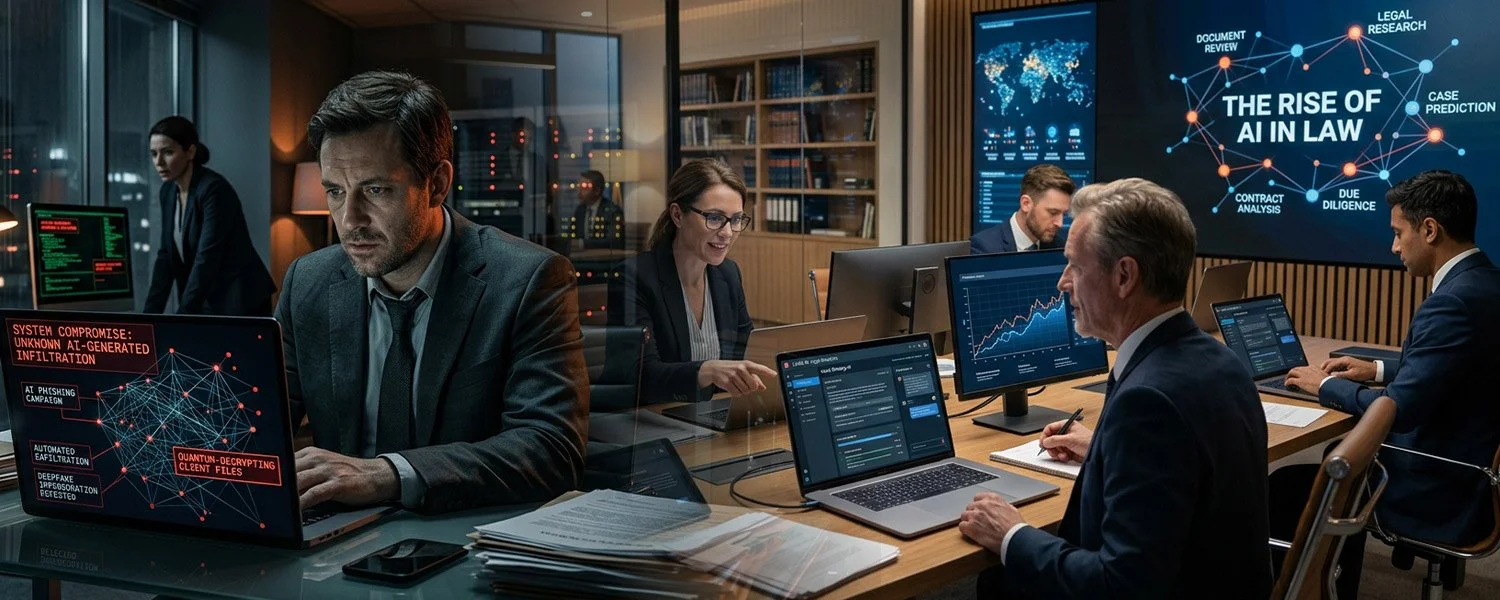
AI is Reshaping the Legal Industry
The legal industry is rapidly changing due to artificial intelligence. AI is being used by law firms to expedite legal research, automate document review, expedite e-discovery, generate contracts, summarize depositions, carry out due diligence, and boost operational effectiveness. AI is becoming essential to the practice of law today, allowing lawyers to work more quickly and provide clients with greater value.
Along with It Comes a New Class of Cybersecurity Threats
However, AI has also given rise to a completely new class of cybersecurity threats. Cybercriminals are able to launch attacks with previously unheard-of speed, sophistication, and scale because of the same technology that makes lawyers more productive.
These days, generative AI is capable of producing realistic deepfake audio and video, automating reconnaissance against targeted organizations, identifying software vulnerabilities, writing harmful code, creating convincing phishing emails free of grammatical errors, and customizing attacks against both clients and attorneys.
Artificial intelligence is evolving into one of cybersecurity's most potent offensive weapons as well as its best defensive tool. The legal profession is the one where this duality is most noticeable.
Law Firms as Appealing Targets
As trusted guardians of some of the most precious information in the world, law firms are particularly appealing targets. Sensitive personal data, government contracts, trade secrets, healthcare records, financial data, protected attorney-client conversations, merger and acquisition strategies, and litigation tactics are all included in their systems.
Law firms are a valuable source of information for nation-state intelligence services, corporate espionage actors, cybercriminals, and ransomware operators. Trust has always been essential in the legal profession. Today, cybersecurity is essential to that trust.
AI as an Attack Automation
The cyberattack lifetime has been significantly shortened by artificial intelligence. It is now possible to automate tasks that formerly needed groups of expert hackers. AI is rapidly being used by criminal groups to search the internet for weak systems, examine lawyers' social media profiles, create customized phishing messages, mimic executive voices, and initiate highly targeted business email hack campaigns.
Poor grammar, odd writing, and questionable formatting, the classic indicators of phishing—have mostly vanished. AI-generated interactions can pass for opposing counsel, a managing partner, or a reliable client.
Imagine that a senior partner leaves what looks like a voicemail telling the accounting department to approve an urgent escrow transfer. or getting an email requesting protected documents prior to a scheduled hearing and correctly referencing private litigation details.
These are no longer hypothetical situations. They stand for the new reality of cybercrime facilitated by AI. The legal profession is especially vulnerable to these attacks because it depends on trust, confidentiality, and timely communications.
Attackers Want Access to Clients
Law companies are increasingly seen by cybercriminals as entry points to their clients.
Attackers frequently find it simpler to compromise outside legal counsel with privileged access to critical corporate information rather than going after a Fortune 500 company directly. Confidential talks, intellectual property portfolios, financial transactions, acquisition plans, regulatory inquiries, or ongoing legal proceedings could all be revealed by a successful hack.
Within bigger digital supply chains, law firms serve as trusted third parties in numerous ways. Their risk is much increased in this position. Ransomware, identity theft, phishing, and corporate email penetration continue to be among the most frequent threat vectors affecting professional services businesses, according to recent industry reports.
The attack surface that businesses of all sizes must contend with has significantly increased due to the growing use of cloud platforms, hybrid work environments, mobile devices, and AI-enabled legal applications. Cybersecurity and data privacy continue to rank among the top issues related to the deployment of AI in law firms, according to numerous studies of legal technology professionals.
These developments support a truth that I have emphasized for years: strong security and governance must coexist with technological advancement. Hackers do more than just target big, international companies. Despite having less cybersecurity professionals and resources, small and midsized businesses may have extremely sensitive client information. It should be considered an objective to protect by every law practice.
Regretfully, a lot of businesses continue to undervalue how appealing they are as cyber targets.
The Rise of New Security Issues
AI is being quickly incorporated into daily operations in the legal industry. Legal research platforms, contract analysis software, client-service chatbots, workflow automation systems, document summarizing tools, and discovery applications are all becoming commonplace business tools thanks to artificial intelligence.
While these developments increase efficiency, they also raise new security issues:
Lawyers unintentionally input private client data into open AI systems
Bad legal research produced by AI that includes fake or erroneous citations
AI systems are tricked into disclosing private information by prompt injection attacks
AI assistants linked to document management systems have been compromised
Model poisoning attacks which affect the results produced by AI
Unauthorized access via AI integrations to private client repositories
Malware created by AI with the express purpose of evading conventional security measures
The stakes are further increased by the development of AI agents that can do research, schedule, draft, and retrieve papers on their own.
These intelligent digital assistants become identities that need governance, ongoing monitoring, authorization, and authentication when they are included into legal operations.
Attorney-Client Confidentiality At Risk
Nowadays, machines have identities that need to be protected. The biggest duty of the profession is still maintaining confidentiality. One of the fundamental tenets of the legal profession is the attorney-client confidentiality.
Confidentiality has always demanded careful attention to detail, but AI has created new challenges. It is therefore necessary for law firms to assess if AI providers save provided data, whether prompts are incorporated into future model training, where client data is held, how it is protected, and who can access it in the end.
Attorneys may unintentionally reveal private information while trying to increase productivity in the absence of defined governance procedures.
And Then There’s Ethics
It comes to ethics. Customers are expecting their outside counsel to exhibit not only legal knowledge but also sophisticated cybersecurity procedures that can safeguard confidential data at every stage of its lifecycle.
Professional competency now includes cybersecurity. For law firms, cybersecurity is now a boardroom concern. Cybersecurity was traditionally thought of as an IT role.
That viewpoint is insufficient now.
Client confidence, regulatory compliance, business continuity, malpractice liability, professional reputation, insurance costs, and company valuation are all directly impacted by cyber risk today. Executive committees and managing partners need to view cybersecurity as an enterprise-wide governance concern.
Businesses should acknowledge that cybersecurity has developed into its own highly specialized field, just as they depend on outside experts in areas like international arbitration, taxation, intellectual property, and healthcare legislation. That change has being expedited by artificial intelligence.
These days, safeguarding digital trust calls upon knowledge that goes much beyond conventional information technology.
Law Firms Need to Anticipate a Different Attack Strategy from Hackers
It is about safeguarding identities, information, confidential communications, intellectual property, client trust, and ultimately, the reputation that every prosperous legal practice depends on. If artificial intelligence has significantly changed the landscape of cyberthreats, it has also changed what law firms should anticipate from cybersecurity experts.
Firewalls, antivirus programs, and recurring compliance checks were the mainstays of cybersecurity in the past. Expertise in artificial intelligence, cloud security, identity and access management, ransomware readiness, digital forensics, threat intelligence, data governance, regulatory compliance, and, increasingly, post-quantum cryptography is required in today's digital environment.
External Cybersecurity Expertise Matters
It is extremely difficult for many law firms, especially small and mid-sized practices, to sustain that level of internal knowledge. Because of this, outsourced cybersecurity subject matter experts (SMEs) are becoming a crucial part of contemporary legal risk management.
Preventing breaches is only one aspect of cybersecurity. The goal is to increase organizational resilience. Anticipating risks, reducing vulnerabilities, effectively responding to incidents, and swiftly recovering while maintaining client confidence and company continuity are the goals. External cybersecurity experts assist businesses in doing just that.
Self-Reliant Proficiency in a Growing Complex Environment
More quickly than almost any other business discipline, cybersecurity is evolving. Within months, attack methods that were unheard of a year ago can become standard. That rate of change has been significantly boosted by artificial intelligence.
External SMEs are able to identify new attack patterns before they impact specific clients since they consistently monitor changing threats across several industries. They provide real-world experience from handling supply-chain assaults, cloud intrusions, insider threats, ransomware instances, company email compromise schemes, and AI-enabled cyber campaigns.
Outside consultants are as important as they offer an unbiased viewpoint. Maintaining daily operations is a common priority for internal IT teams. External specialists assess systems from the perspective of an opponent, spotting flaws that could go unnoticed otherwise.
This impartial evaluation often turns into one of the company's most valuable cybersecurity resources.
Identity as the New Security Perimeter
The disappearance of traditional network perimeters is one of the biggest changes in cybersecurity. These days, lawyers work from homes, offices, airplanes, client locations, and courtrooms.
They frequently use third-party legal apps, mobile devices, cloud-based document repositories, AI assistants, and collaborative platforms. Identity itself has evolved from the periphery. Every lawyer, employee, contractor, vendor, application, and increasingly every AI agent is a digital identity that needs to be vetted, authorized, tracked, and validated on a regular basis.
This development demonstrates why Zero Trust Architecture has emerged as one of the key cybersecurity tactics of our day. Zero Trust is based on the straightforward yet effective idea that people within a network cannot be trusted: Never put your faith in someone. Instead, ensure that your strategy includes the following:
Multi-factor authentication that is resistant to phishing
Controls for least privilege access
Constant verification
Management of Privileged Access (PAM)
Identity management and governance
Safe remote access
Segmenting a network
Constant observation of user behavior
Sensitive customer data encryption
These identity-centric security models may be planned, implemented, and continuously improved by companies with the help of outside cybersecurity experts.
Governance Is Needed for Artificial Intelligence
AI governance is one of the legal company leadership's fastest-growing duties.
Many businesses have embraced generative AI tools more quickly than they have created usage guidelines. Unnecessary risk is created by the imbalance. AI governance that works goes beyond technology. Legal ethics, professional accountability, intellectual property, privacy protection, regulatory compliance, and cybersecurity are all included.
Formal policies should be established by every legal practice that address:
Utilizing both public and private AI systems appropriately
Preservation of the attorney-client privilege
Human evaluation of legal work produced by AI
Verification of case references and legal citations
Safe management of private customer data
Evaluations of third-party AI vendors
Quick engineering guidelines
Keeping an eye out for hostile attacks and prompt injection
Secure APIs that link internal repositories to AI systems
Supervision of self-governing AI agents
Without sacrificing confidentiality or professional commitments, external consultants can assist legal firms in creating governance structures that foster innovation.
Cloud Security Is Now Essential
Legal procedures have undergone a profound transformation thanks to cloud computing. Cloud environments are being used by document management systems, e-discovery platforms, billing systems, client portals, and collaboration tools.
Information protection is still a shared responsibility even though cloud providers make significant investments in security. Identity controls, encryption, configuration management, data classification, backup plans, and ongoing monitoring must all be properly implemented by law firms.
Sensitive data in numerous businesses is still exposed by improperly setting up cloud storage. Before vulnerabilities become public breaches, external SMEs regularly assess cloud infrastructures, find configuration flaws, and suggest fixes.
Practice Related Supply Chains Require Review
An ecosystem of technology vendors is essential to any legal practice:
Providers of document management services
E-discovery websites
Cloud-based hosting firms
Systems for accounting
IT service providers under management
AI programmers
Experts in digital evidence
Every connection is an additional point of entry for potential attackers. Attackers often use trusted vendors as a gateway into larger enterprises, as recent years have shown. Therefore, supply-chain security merits the same consideration as internal cybersecurity.
Vendor risk assessments, contractual security requirements, third-party control reviews, and continuing monitoring programs can all be carried out by outside cybersecurity experts. The entire digital ecosystem needs to be trusted.
Getting Ready for the Unavoidable
No company can ensure total protection against cyberattacks, no matter how hard they try.
As a result, resilience becomes equally crucial to prevention. Before a crisis arises, external cybersecurity advisers assist businesses in creating thorough incident response plans that include roles.
Included in the preparation should be:
Exercises for executive tabletops
Planning a response to ransomware
Readiness for digital forensics
Planning for business continuity
Testing for disaster recovery
Communications during a crisis
Procedures for regulatory notice
Strategies for client communications
Coordination of cyber insurance
Protocols for law enforcement engagement
Surviving a cyber-attack is not the only goal
It is preserving customer confidence while expeditiously reestablishing activities.
A Contemporary Cybersecurity Structure for Law Firms
The legal cybersecurity approach of today should be all-encompassing, risk-based, and constantly changing. A successful framework ought to consist of:
Oversight
Executive supervision
Policies for cybersecurity
Governance of AI
Risk management via third parties
Identify
Inventory of enterprise assets
Classification of data
Management of identities
Risk evaluations safeguard
Architecture with Zero Trust
Encryption, multi-factor authentication, and endpoint detection and response (EDR)
Cloud architecture that is secure
Training in security awareness
Threat detection with AI assistance
Monitoring by the Security Operations Center (SOC)
Intelligence about threats
Analytical behavior
Ongoing vulnerability management Response
Plans for responding to incidents
Forensics using digital means
Coordination of laws and regulations
Communications during a crisis
Recuperate
Continuity of business
Recovery from disasters
Takeaways
Constant improvement
This strategy incorporates the realities of AI-enabled cyber threats and contemporary legal operations while carefully adhering to the principles outlined in the NIST Cybersecurity Framework.
Using Cybersecurity to Gain a Competitive Edge
Sophisticated customers are increasingly considering cybersecurity when choosing outside counsel. Mature security practices are expected of legal partners by corporate boards, financial institutions, healthcare organizations, government agencies, and operators of key infrastructure. Cybersecurity is becoming a differentiator.
Confidence is increased by robust security. Trust is built on confidence. And the cornerstone of any fruitful lawyer-client relationship continues to be trust. Therefore, investing in outside cybersecurity knowledge is more than just a defensive strategy.
It is an investment in the company's competitiveness, resilience, and long-term reputation.
Building The AI Resilient Law Firm
Artificial intelligence is more than just a passing fad in technology. It signifies a major change in the way law firms’ function, interact, cooperate, and safeguard information. AI is also changing the strategies used by organized ransomware organizations, nation-state enemies, and crooks.
Businesses that embrace innovation and incorporate cyber resilience into every facet of their business will be the ones who prosper over the next ten years. It is time to stop thinking of cybersecurity as a technical expense.
It is an investment in competitive advantage, ethical responsibility, business continuity, and client trust.
One theme has persisted throughout my career as a writer about cybersecurity and emerging technologies: resilience is the ultimate goal. There is never complete security. Threats will keep changing. New vulnerabilities will be brought about by new technology. Successful businesses are characterized by their capacity to foresee change, get ready for disruptions, react efficiently, and bounce back fast.
This is a philosophy that is more important than ever for legal firms.
Getting Ready for the Quantum Age
Another technological revolution is on the horizon, even as AI dominates today's news. Significant advances in the fields of medicine, materials science, logistics, financial modeling, and scientific research are anticipated thanks to quantum computing.
However, it also poses one of the biggest long-term cybersecurity issues to date.
Almost all digital interactions are now protected by public key encryption, including banking transactions, digital signatures, cloud storage, and attorney-client conversations. Many of today's encryption protocols may eventually become outdated because to cryptographically relevant quantum computers.
Adversaries are already using "Harvest Now, Decrypt Later" tactics—stealing encrypted data now with the hope that it may be decrypted later—even if widespread quantum capabilities may still be many years distant. This problem needs to be addressed right now for law firms that handle extremely sensitive client data.
To prepare for quantum security, law firms should address:
Cryptographic asset inventory
Crypto-agility development
Tracking the use of post-quantum cryptography techniques that have been specified by NIST
Collaborating on migration plans with technology suppliers
Assessing the long-term security needs for private legal documents
Businesses who start planning now will be in a far better position tomorrow
AI Agents: The New Frontier in Cybersecurity
The creation of AI agents is among the most significant advances in AI.
AI agents may carry out a series of tasks with growing autonomy, in contrast to conventional chatbots. Document retrieval, legal research, case law summaries, contract drafting, calendar management, discovery analysis, workflow coordination, and direct interaction with corporate applications are all possible tasks for them. These features provide enormous increases in productivity.
Additionally, they establish completely new security obligations.
Each AI agent ought to be regarded as a unique digital identity. AI bots must function under clearly defined permissions, ongoing monitoring, and human control, much as lawyers need authentication and authorization. Businesses should be aware of:
What data is available to an AI agent
Which systems it can communicate with
What is it capable of doing
Who is responsible for its choices
How its actions are recorded and examined
People are no longer the only ones involved in identity governance. It increasingly encompasses intelligent machines that act on human behalf.
Creating a Cyber-Resilient Culture
Cybersecurity cannot be solved by technology alone. People continue to be the strongest defense and the worst vulnerability. Ongoing education that goes well beyond yearly compliance training is necessary to build a resilient culture. The following growing hazards should be understood by lawyers, paralegals, legal assistants, administrators, and firm leadership:
Phishing attacks produced by AI
Deepfake video and audio
Compromise of business emails
Threats from within
Using generative AI safely
Client privacy
Security of mobile devices
The use of social engineering
Cloud cooperation
Obligations regarding data privacy
Professional development should emphasize that employee has a duty to protect client information
A Hygiene Checklist for Law Firms
Effective cybersecurity still starts with good cyber hygiene. These procedures are more crucial than ever in the AI era:
Leadership and Governance
Establish cybersecurity as a top priority for company executives.
Create official AI governance guidelines
Assign cyber risk management to an executive
Perform yearly evaluations of enterprise cyber risk
Keep your incident response plan up to date
Security of Identity:
Demand multi-factor authentication that is resistant to phishing
Use password managers throughout the company
Use the principles of least-privilege access
Install PAM, or privileged access management
Keep an eye on privileged accounts and user identities at all times
Artificial Intelligence:
Before using AI tools throughout the entire company, approve them
Prevent unauthorized public AI systems from accessing private customer data
AI-generated legal work must be reviewed by humans
Verify legal citations and research produced by AI
Keep an eye out for anomalous activity and unauthorized access in AI applications
Safeguarding Customer Data:
Sensitive data should be encrypted both in transit and at rest
Sort private customer information
Safe cloud storage
Examine data retention policies on a regular basis
Get rid of outdated digital media safely
Protection of Infrastructure:
Continue patching software automatically
Implement Endpoint Detection and Response (EDR)
Keep an eye on networks all the time
Perform penetration tests on a regular basis
Use immutable backup techniques to protect important systems
Supply Chain and Vendor Security:
Examine external vendors' cybersecurity policies
Examine the security measures implemented by AI vendors
*Contracts should incorporate cybersecurity standards
Keep an eye on third-party access
Workers' Awareness:
Perform phishing simulations on a regular basis
Educate staff about hazards enabled by AI
Teach staff how to spot deepfakes
Promote reporting questionable activities right away
Resilience in Business:
Examine disaster recovery protocols
Perform executive tabletop exercises
Every year, review your cyber insurance policy
Work with law enforcement, insurance, and outside attorneys to coordinate incident response
Getting Ready for Tomorrow:
Start preparing for post-quantum cryptography
Stock up on cryptography resources
Evaluate the security of AI agents
Every year, review your cybersecurity approach
Encourage a culture where digital trust is integrated into the company's identity
An Era of Unparalleled Technology Disruption is Here
A moment of unparalleled technological change has begun for the legal profession. Artificial intelligence will continue to develop new legal practices, increase productivity, and improve legal services.
Cyber threats will also grow more automated, adaptable, and challenging to identify.
AI-assisted defense, behavioral analytics, ongoing identity verification, autonomous threat detection, and eventually quantum-resistant cryptography will be key components of future cybersecurity tactics.
Law firms cannot continue to operate in a reactive manner. They need to start taking initiative. Cybersecurity is now much more than just safeguarding computers and networks. Now, the focus is on safeguarding digital trust.
Attorney-client privilege, intellectual property, financial transactions, litigation strategy, corporate governance, and the trust clients have in their legal counsel are all included in this trust for law firms.
The prospects and risks facing the legal profession have been profoundly altered by artificial intelligence. Stronger governance, increased watchfulness, ongoing education, and closer cooperation between lawyers and cybersecurity experts are all necessary.
External cybersecurity subject matter experts offer the unbiased viewpoint, specific knowledge, and strategic direction required to assist businesses in navigating this quickly changing environment. They make it possible for legal organizations to plan for future risks in addition to defending against current ones.
Businesses with the biggest technological spending won't always be the ones that stand out in the next ten years. They will be those that successfully combine artificial intelligence with responsible human oversight, resilience with governance, and innovation with security.
Cybersecurity and the profession of law are now inextricably linked in the digital age. One idea has not changed as artificial intelligence continues to transform the legal industry: a law firm's most precious asset is its trust and safeguarding that trust starts with creating a strong cybersecurity culture.
Chuck Brooks is a globally recognized thought leader, strategist, and subject matter expert in cybersecurity, artificial intelligence, and quantum technologies. As President of Brooks Consulting International, Brooks brings over 30 years of multidisciplinary experience spanning government, corporate strategy, academia, media, and strategic advisory roles.
Brooks is a leading voice in understanding how artificial intelligence, quantum computing, 5G, IoT, and blockchain technologies are reshaping the cybersecurity landscape and organizational risk management. His expertise spans critical infrastructure protection, zero-trust architectures, post-quantum cryptography, AI-driven threat vectors, and the dual-use
A two-time Presidential Appointee, Brooks served as the founding Director of Legislative Affairs at the U.S. Department of Homeland Security Science & Technology Directorate, establishing him as a bridge between policy innovation and technical implementation. He has briefed the G20 on energy-sector cybersecurity, addressed the U.S. Embassy to the Holy See and Vatican on global cybersecurity cooperation, and advised USTRANSCOM, the FBI, National Academies of Sciences, and DHS CISA working groups on critical security challenges. Additionally, he served as a senior advisor to the late Senator Arlen Specter on Capitol Hill covering technology and security issues.
Brooks has held senior executive roles at leading defense and technology firms including General Dynamics, Xerox, Rapiscan, SRA International, and Sutherland Government Solutions, where he developed strategic market growth, government relations, and technology commercialization initiatives. He was a Technology Partner Advisor to the Bill & Melinda Gates Foundation and serves on multiple advisory and board positions with organizations focused on cybersecurity, homeland security, and digital innovation.
He is a prolific author and contributor, having published over 450 articles and analyses in prestigious outlets including Skytop Media where he is contributor to publications, a conference speaker, and where he hosts “Intelligence Briefing, a TV show streamlined across over a dozen media platforms. He has also been a contributing writer to Forbes, Dark Reading, The Hill, Homeland Security Today, Security Information Watch, Barons, Federal Times, and many others, focusing on emerging threats, AI implications, quantum risks, and digital resilience. He is the author of "Inside Cyber: How AI, 5G, IoT, and Quantum Computing Will Transform Privacy and Our Security" (Wiley), a comprehensive guide helping organizational leaders navigate converging technological disruptions.
Brooks commands a global following of over 134,000 on LinkedIn, where he was recognized by LinkedIn as one of the "Top 5 Tech People to Follow". He operates multiple high-impact LinkedIn groups focused on cybersecurity, homeland security, emerging technologies, and thought leadership. Additionally, he maintains 75,000+ subscribers to his "Security and Tech Insights" newsletter, establishing him as a trusted voice for technology and policy intelligence.
A frequent keynote speaker at major global conferences and industry events, Brooks has addressed audiences on the intersection of technology, security, and policy. His thought leadership activities have directly shaped public policy debate and organizational strategy across Fortune 500 companies, government agencies, and international bodies. Brooks was named "Top Cybersecurity Expert to Follow on Social Media," recognized as one of the top cybersecurity leaders.
He is an Adjunct Professor in the Georgetown University Cyber Risk Management and Applied Intelligence graduate programs, where he teaches courses on risk management, cybersecurity, quantum, blockchain, and disruptive technologies. His curriculum bridges theoretical frameworks with practitioner insights from his extensive government and corporate experience. He was recently honored by Georgetown University with the Outstanding Faculty Award (Tropaia Award) for exemplary academic achievement, leadership, and character.
His degrees include Master of Arts in International Relations, University of Chicago | Bachelor of Arts in Political Science, DePauw University | Certificate in International Law, The Hague Academy of International Law
He can be reached at Chuck Brooks Bio — SKYTOP